

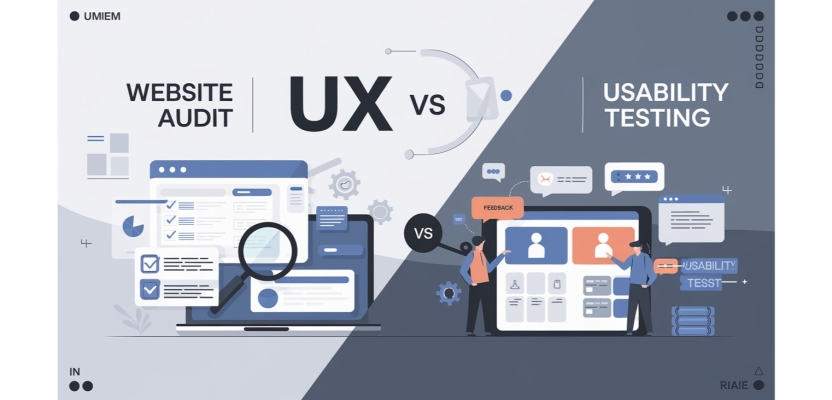

Is your website struggling with high drop-off rates, low conversion rates, or negative user feedback? Get a website UX (user experience) audit.
UX auditors will be able to identify all the design flaws and usability roadblocks hindering user satisfaction on your website.
However, the website UX audit will be performed by UX design experts and accessibility specialists.
While these specialists or experts are worth their weight in gold, they cannot replace your website’s users and their unique points of view. That is why every struggling website needs more than just UX audits - they also need usability testing.
Let us break down both of these procedures - UX audits and usability testing to find out why every website needs both from time to time.
UX Audits and Why Websites Need Them
A UX audit is a systematic evaluation of a website’s user interface (UI) and user experience (UX).
This evaluation is data-based and it reveals all the technical and design flaws plaguing the site and preventing it from meeting user needs and expectations. This includes:
-
All major friction points on the site (pages with high drop-off rates, design issues preventing conversions, etc.)
-
Design inconsistencies
-
Accessibility issues
-
Missed opportunities (places where the website’s design could’ve been better at addressing user needs)
By, ‘data-based,’ we mean that all the flaws the UX audit reveals, are backed by data. By implementing the data-based recommendations from the UX audit, website designers can improve their site’s UX, visual aesthetic, and technical features in a verifiable way.
Why Do Websites Need UX Audits?
Websites need UX audits to understand why users do what they do on a website. Auditors measure, test, and evaluate all UX and accessibility-related aspects of the site, including:
-
The site’s Information Architecture to review whether the content on the site is structured, labeled, and presented in ways that are easy for users to digest, navigate, and derive value from.
-
The website’s visual style (typography, imagery, color palettes) to determine whether it creates a clear visual hierarchy that’s aligned with user needs/expectations.
-
The site’s overall design system (visual elements, navigation menus, CTA buttons) to determine whether they are consistent and cohesive enough to give users a sense of comfort.
-
The site’s ability to consistently facilitate positive interactions by studying user interaction data with clickstream analysis, heatmap analysis, accessibility testing, and eye tracking.
To evaluate these factors, UX auditors perform:
-
Heuristic analysis where they review the site’s design elements against industry-established design and usability standards.
-
Eye tracking where they track users’ eye movements on the screen as they explore the site.
-
Heatmap analysis to understand the most and least attention-drawing sections of the website.
-
Clickstream analysis where they analyze the click and navigation patterns of users to identify friction points and deconstruct their journeys.
-
Analytical assessment where they study the site’s bounce rates, average on-page time, exit rates, session time comparisons, and other analytical data.
-
Expert reviews where they bring in specialists; when auditing a business site, auditors bring in business site admins to identify missed opportunities in the site’s design.
UX auditors may perform other tests, depending on the site and the types of issues they are dealing with. The point of all of these targeted studies is to reveal all the strengths and weaknesses of the website’s design.
Based on these revelations, the auditors also suggest targeted improvements for the website’s design team. By following these recommendations, the designers can make their site more intuitive, engaging, and up-to-date with the latest design standards.
When to Perform Website UX Audits?
A website UX audit can provide value throughout a website’s lifecycle. Conducting UX audits on website prototypes, long before the actual site is launched can help the design team address UX issues before they become expensive problems.
UX audits are especially useful in improving websites that have poor KPIs and analytics. They are also great for assessing old sites and highlighting what sections need immediate updating.
Usability Testing and Why Websites Need Them
While UX audits are great for identifying all the major problems in a website – they do not involve real users. Unless your web design efforts involve your users (a diverse mix of people from your target audience), they’ll always fall short in some way or another.
Hence, usability testing is very important. This research method involves observing users as they interact with a website. It allows researchers to gain firsthand insights into whether users can efficiently and effectively complete tasks on your site in real-world contexts.
By providing users with specific tasks - such as “find page 7 in the blog section” on a website, - and encouraging them to verbalize their thoughts during navigation, usability testing helps identify issues with site navigation and intuitiveness.
Why Do Websites Need Usability Testing?
The primary goal of usability testing is to uncover problems within a website’s design and find opportunities for new design improvements – while seeing it through the users’ eyes. Even the best web designers cannot fully anticipate how actual users will interact with a product in real-world scenarios. That is why seeing the site through the users’ eyes is vital.
This method is particularly helpful for global websites that need to address questions related to their vast user base’s cultural differences, biases, and accessibility issues. Usability testing helps bring to light problems that are faced by the site’s diverse user groups. By understanding how different groups interact with the site, designers can create more inclusive website experiences.
To conduct a usability test, UX researchers create carefully crafted task lists that guide users through the testing process. Tasks should be clear yet open-ended enough to allow users some autonomy in their navigation. For example, rather than simply asking users to explore the site, a more directed task might be to “find out what customization options are available for walls on this paint company’s site.” The wording of these tasks is crucial; overly directive prompts can lead to biased results.
Researchers also record user interactions during the test session. This can include video recordings of the user navigating the screen while thinking aloud, as well as notes taken by the researcher during moderated tests. To enhance usability testing further, advanced techniques such as eye movement tracking and heat mapping can also be employed.
The output from usability tests includes both recorded sessions of participants navigating through tasks and detailed notes from researchers observing these interactions. However, relying on a single usability test may not yield comprehensive insights since individual behaviors can vary widely. To effectively analyze usability tests, it is necessary to conduct multiple sessions with diverse participants and compare results across tests.
This aggregate analysis helps identify common pain points or frustrations experienced by users:
-
Where did participants tend to get confused or frustrated?
-
Did multiple users express similar thoughts regarding specific elements during their tasks?
Based on these observations, usability test results typically culminate in actionable recommendations for improving the digital product's design. By addressing identified issues in subsequent iterations, designers can create more user-friendly interfaces that enhance overall satisfaction.
When to Perform Usability Testing?
Usability testing should be performed periodically, throughout the site’s lifecycle. Regularly revisiting usability tests allows teams to adapt designs based on evolving user needs.
Continuous testing also fosters an iterative web design approach where user feedback is given the importance it deserves and consistently integrated into design and development cycles.
Conclusion
Almost every leading website UX audit company today performs usability testing. So, you do not need to hire two sets of UX specialists every time you want to fortify your website’s design! Just find experts who can do both and give both research methods equal levels of importance.