
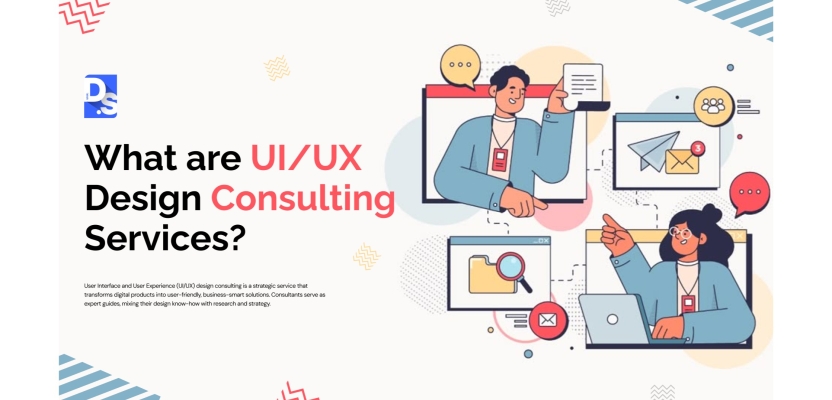

User Interface and User Experience (UI/UX) design consulting is a strategic service that transforms digital products into user-friendly, business-smart solutions. Consultants serve as expert guides, mixing their design know-how with research and strategy.
Like almost every activity in the UI/UX field, this service starts with understanding users. Consultants dig into behaviors, preferences, and pain points through surveys, interviews, and data analysis. They also study the business side to understand the clients’ goals – be it boosting sales or cutting support costs. From there, they craft solutions that bridge the gap between what users want and what the company needs.
Take a mobile banking app as an example. A consultant might spot that users abandon it during sign-up. Through research, they uncover confusing steps or unclear prompts. Then, they suggest interface tweaks and test them until the app feels effortless to use. They won’t stop working until the goal of completing more registrations is achieved.
That’s consulting in action - practical, data-backed, and focused on results. In essence, UI/UX design consulting is about adding value to products that have unrealized design potential. Do you have such a product on your roster? Here’s all that you need to know about professional UI/UX design consulting services and how they can help.
How Is UI/UX Design Consulting Different from General UI/UX Design?
At first glance, UI/UX design and UI/UX consulting might seem like two sides of the same coin. Both aim to make digital products better. But their approaches and scope are quite different.
General UI/UX design is hands-on and project-specific. Designers get a brief - say, revamp a website’s homepage - and they jump in. They sketch wireframes, build prototypes, and polish the final look. Their focus is execution. They solve defined problems within a set scope, often working solo or in small teams. It is about creating deliverables, fast and efficiently.
UI/UX design consultants have different responsibilities. For them, it is less about doing the actual design work and more about steering it. Consultants start with questions, not solutions. They research users, markets, and competitors to uncover what is really going on. Instead of just building a homepage, they ask: Why are users leaving? What is the business trying to achieve? Their role is answering these questions and crafting strategies to help the design team solve all pressing UI/UX issues.
Another big difference is perspective. In-house designers often have tunnel vision and get stuck in company habits or assumptions. Consultants swoop in with fresh eyes, spotting UI/UX issues insiders might miss. They also bring specialized skills - like expertise in fintech interfaces or enterprise software - that internal teams might lack.
The way UI/UX designers and UI/UX consultants collaborate sets them apart, too. General designers often stay in their lane, handing off assets to developers. Consultants cross boundaries, working with design, tech, marketing, engineering, and leadership to ensure that the final design supports broader brand goals.
Think of it like this: if general UI/UX design builds the house, UI/UX design consulting refines its blueprint, readjusts its location, and ensures that it is built to last. Consultants shape why and how a product exists; designers execute the what.
The Impact of UI/UX Design Consulting
Some of the best UI/UX design consultants in the game show how impactful these services can be. IDEO is a prime example. They are legends in design thinking and the first to use the human-centered design approach to craft standout digital experiences. Their consulting work with Ford has influenced every car-buying app in existence today. IKEA famously used its consulting services to rethink its digital shopping routes.
Then there’s Adam Fard Studio, a go-to for B2B, fintech, and SaaS firms. Their consulting has helped firms like Revolut sharpen user activation with sleek, practical interfaces.
Frog Design is another heavy hitter in this field known for transforming experiences for Apple and Disney with bold, user-first designs.
These firms show that acquiring UI/UX consulting services can lead brands to a variety of measurable gains - higher engagement, smoother journeys, and happier users.
When Do Companies Seek UI/UX Design Consulting Services?
The main reason why businesses call in UI/UX consultants is when they are stuck in their own bubble and often need a fresh take. Internal teams can miss flaws they are too close to see. Consultants break that cycle with an outsider’s clarity. The specialized skills they bring in are also a draw for businesses in similar predicaments.
If a firm lacks know-how in, say, AR interfaces, consultants fill it fast. They add bandwidth to a company’s design expertise without the overhead of new hires. In most cases, consultants are brought in to optimize live products that have a lot of resources invested in them. A company might notice users dropping off mid-flow. Consultants dig in, find the snag, and fix it. Transforming underperforming products into revenue magnets requires strategic vision and real-world experience. Consultants offer exactly that.
Competition can also force their hires. If a rival rolls out a slick new feature, consultants help leapfrog it with something better.
In each case, these services tackle what internal design teams can’t.
The UI/UX Consulting Process: From Insight to Impact
While every UI/UX consulting project is different, here’s how they usually go. The journey always begins with a discovery workshop. In an initial collaborative deep dive, consultants talk with stakeholders to dissect business goals, audit existing interfaces, and map out the product’s ecosystem of users, decision-makers, and technical constraints.
Next, UX research takes center stage: consultants deploy surveys, conduct interviews, and analyze heatmaps to uncover hidden pain points. Imagine a healthcare app where users struggle to navigate prescription refills; here, behavioral data might reveal cluttered menus or unclear CTAs as culprits. Armed with UX research insights, consultants craft detailed personas and journey maps - tools that humanize data by visualizing user frustrations, motivations, and workflows. These artifacts help the team prioritize UI/UX fixes based on their severity and impact.
Prototyping follows, with consultants creating low-fidelity mockups, high-fidelity designs, and other prototypes of their proposed design solutions. These solutions are then rigorously tested with real users and further refined.
Once designs are polished, consultants pivot to the implementation stage. They help the design team bridge the gaps between their vision and the actual code of the product. They work with developers to fine-tune details like ensuring all buttons trigger the right actions, making all animations feel smooth, and ensuring brand aesthetics look consistent across the UI.
Post-launch, their work might evolve into monitoring (depends on what type of contract you have) - tracking metrics like bounce or conversion rates to consistently refine the experience.
How UI/UX Consulting Fuels Business Success
Acquiring professional UI/UX consulting can be a growth multiplier for a business with one or multiple digital products. By smoothing friction in user journeys, companies can see direct revenue lifts. A redesigned checkout flow for an eCommerce, for example, might spike conversions by 15%, translating to millions in annual revenue.
Cost savings also follow naturally, as early UI/UX issue detection in audits prevents costly post-launch fixes. Brand loyalty also thrives when a company’s digital experiences feel intuitive. Internally, well-designed tools boost employee productivity - a clunky CRM overhauled by consultants can save hours per week per employee.
A brand’s competitive edge sharpens when consultants infuse products with innovations like voice navigation or AR previews - features that differentiate a product in crowded markets.
Finally, hiring UI/UX consultants today can future-proof a brand’s digital presence for years.
Conclusion
UI/UX design consulting services play a crucial role in transforming digital products into user-centered, business-driven solutions. By offering strategic insights, fresh perspectives, and specialized expertise, consultants optimize user experiences, streamline processes, and fuel business success. Their work leads to higher engagement, improved conversion rates, and sustained brand growth. Whether you are fixing a floundering app or launching a game-changing SaaS tool, acquiring top-quality UX/UI consulting services can give your digital product a massive edge.