

In an era where digital engagement is paramount, Synoptic Office has masterfully reimagined Neue Galerie New York's online identity, crafting an immersive platform that mirrors the museum's physical allure.
We caught up with partners and co-founders YuJune Park and Caspar Lam, to explore how they seamlessly blended art, history, and architecture to extend the museum's reach beyond its Fifth Avenue location, inviting global audiences to experience the rich tapestry of early twentieth-century Austrian and German art and culture.
What was the brief for the rebrand?
Neue Galerie New York approached us with long-established branding, which was formed by Pandiscio Green, and a desire to reconsider the brand in a digital context. Like many museums and institutions, the pandemic prompted the Neue Galerie to rethink how to engage and inspire audiences who could not visit in person. The Neue Galerie needed a practical digital platform that would welcome a global audience to explore the museum digitally while still communicating the poetics of the Austrian and German art and culture it offers.
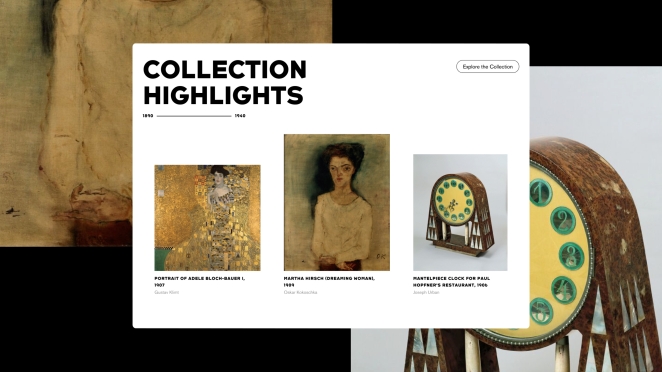
When considering our new online identity, we leaned into Neue Galerie New York’s existing branding and the design philosophy of Gesamtkunstwerk, a German word that roughly translates to “all-encompassing work of art.” We wanted to translate the old-world experience of physically entering the Neue Galerie’s historic jewel-box space for a digital context.
Describe the purpose of the brand and its target audience
Neue Galerie New York is a museum for Austrian and German art of the early twentieth century. Located on New York’s famous Museum Mile on Fifth Avenue, the Neue Galerie houses the largest collections of works by Gustav Klimt and Egon Schiele outside Vienna. It also features the Viennese-inspired Café Sabarsky and a highly curated Book Store and Design Shop, which celebrate the history and allure of the art and culture of this particular time and place.
Bringing these elements through strategic design and motion, we created an immersive digital platform that virtually captures the feeling of wandering through the museum and shares all that the museum offers with global audiences.
What was your thinking behind the digital redesign solution?
As with all digital collections, the site architecture was key to ensuring an enjoyable experience for the visitor. Navigation needed to be clear and intuitive, while still telling the story of the museum and its collections.
We wanted the platform to invite visitors to explore all aspects of the museum experience – exhibitions, public programs, dining, shopping – without taking away focus from the artwork itself. These different parts of the experience – the art forms and creative processes working together to create a cohesive whole – are referred to as a Gesamtkunstwerk, which in German translates roughly to “all-encompassing work of art.”
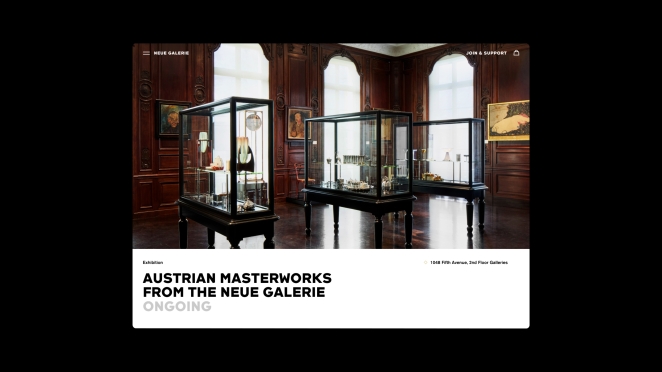
We wanted the website to be a true extension of the museum, to somehow capture the totality of this experience for the online visitor where culture, history, and the artworks live side by side. To improve visitor circulation around the site, we integrated a related objects module into every page. This allows users to seamlessly move from an exhibition to the shop, for example, and vice versa. The website also invites visitors to continue the experience offline with immersive imagery and video that beckon the visitor to experience the collections firsthand.
What was the biggest challenge? How did you overcome it?
The biggest challenge we had with the site was trying to capture the jewel-box experience that visitors encounter when they visit the museum in person. The sensory delights – from the art and architecture to the café – at the Neue Galerie transport visitors to another time and place. Translating this to the screen was one of the most difficult but delightful parts of the project.
What kit/tools/software were used to create it?
One of the most unique technical features of the site is that the museum site and its e-commerce store are fully integrated. We were able to leverage a robust API to connect the Neue Galerie’s e-commerce system with a headless CMS so that visitors never leave the site.
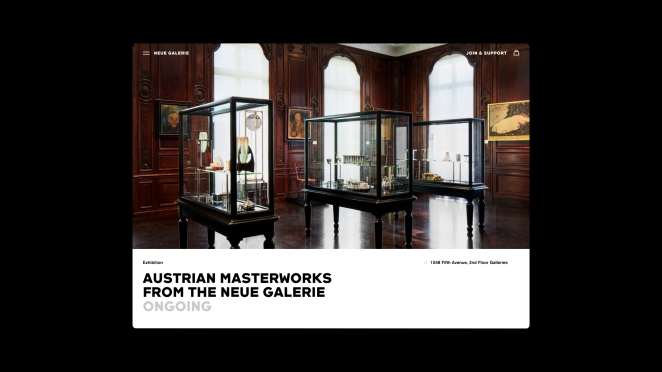
Learning about the collections and finding a way to bring home a piece of history through the online shop are seamlessly integrated in the online visitor experience.
What details are you most proud of any why?
All collections have a reason for being, and finding and telling that story to the visitor is integral to the success and longevity of interest in a museum. We worked closely with the Neue Galerie to translate this story on a digital platform, retaining the poetry of the collection while ensuring the site is practically functional.
Since launching the website, online visitors have increased their time spent across it by 26% per visit. User engagement on storytelling pages increased upwards by 73%.
Can you discuss any innovative or unconventional approaches you took in developing the rebranding solution?
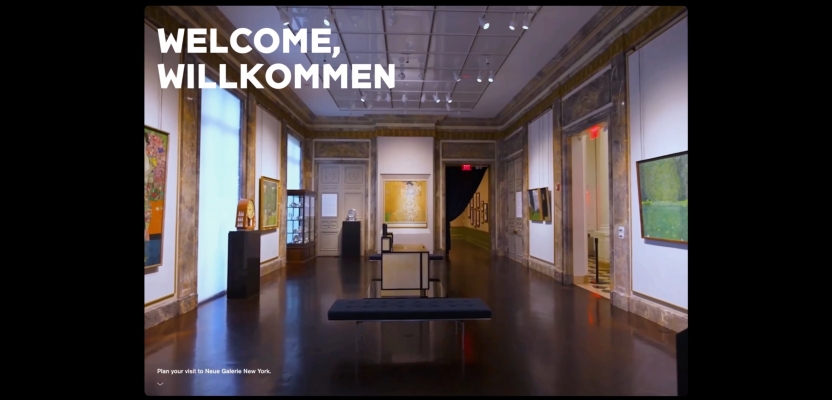
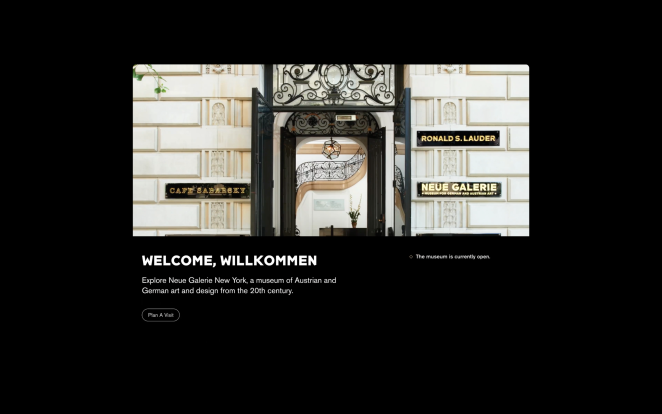
We wanted to communicate the sensation of exploring a physical space, so we used motion to creatively showcase content across the website. Just like in real life, the visitor finds themselves standing outside the museum on the website’s landing page, and navigates via video, through the front door into the collections and historic spaces.
This specific welcome video not only helps transport the visitor but also showcases the museum itself. The Neue Galerie is located in one of the few surviving Gilded Age mansions on New York’s Fifth Avenue, itself a stunning work of architectural art and history. The videography concept across the site – produced by the museum’s communications and creative strategy department led by Michelle Perlin, working with the creative services company SandenWolff – is immersive and intended to welcome you inside the building and the collection. The videos often fill up the full screen, so the visitor truly experiences their arrival into this special space.
What do you hope it achieves for the brand?
The new site allows the Neue Galerie to become truly borderless, preserving and sharing its knowledge with the broadest possible audience. That’s what we always hope for with our work – to make collections accessible to all, unlock the human stories behind these masterpieces, and spark conversation. Digitalization simply means that the human spirit behind the art can impact more lives.