

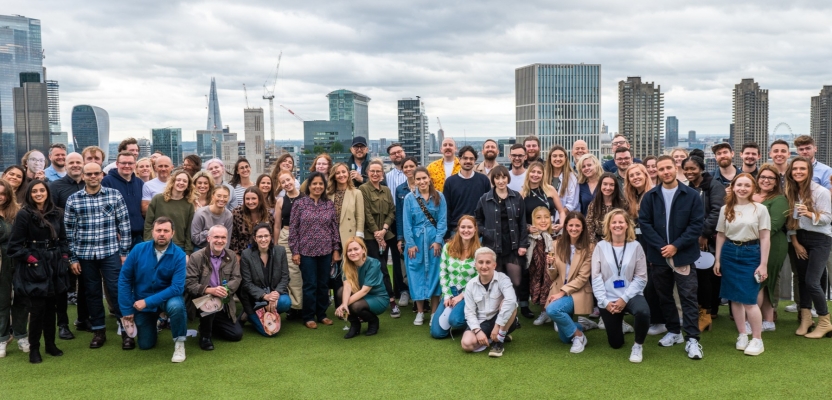

Co-founded by Kate Ross and Amy McCulloch in the wake of the 2008 recession, eight&four has grown from a daring startup into a 100-strong powerhouse in the heart of London. In this exclusive interview, Kate Ross takes us through the journey of eight&four, from its early challenges to becoming a leader in AI-driven marketing solutions, while maintaining a culture of innovation and collaboration
How was your company born and where are you based?
Myself and Amy [McCulloch] met on a graduate scheme at Reed Elsevier in 2006 where they wanted to train us up on this exciting new concept called Digital Marketing. Two years later the recession hit and we felt that, with the skills we’d learnt, it was a great opportunity to go and sell directly to clients. So we struck out on our own! We’re now based in Old Street, London, and have a staff of around 100.
What was the biggest challenge to the growth of your company?
Us! We were 24 years old, we had no contacts, we’d never worked at an agency before so had no idea how to work with clients or scope work. Those first two or three years were very brutal. But agency life is pretty brutal anyway - the client expectations, the hours and so on.

You win and lose on a dime and yet an entire agency’s fortunes depend on your clients. That’s a lot when you’re only 24. It takes someone to put their faith in you to get you up and running and we were very lucky that some people - predominantly women SME owners - did that.
Which was the first huge success that you can remember?
One that always really stands out is when we won our first government contract. Suddenly we felt this sense of credibility. We applied for a tender from Wandsworth Council to rebuild Balham.com, a £5,000 project which was huge to us at the time. I can still remember winning it, both of us jumping around on my coffee table. That was a really big milestone.
What’s the biggest opportunity for you and your company in the next year?
Over the past two years we’ve been building out our response to Gen AI technology. Platform12, which is now a full AI tool suite that our clients sit upon, continues to evolve and develop all the time. Feedback has been outstanding - it’s been a key differentiator in pitch wins these last 12 months. The evolution of that will be critical for the next 12 months.
Can you explain your team’s creative process? What makes it unique?
I don’t think creative processes are particularly unique. The fundamentals of great creative processes are always how you’re listening to consumers and audiences, what’s going on, and how you are aware of that, within culture. And how you’re ensuring everyone gets a piece of ideation in the agency - in an open, shared and democratic way. That’s not a locked room thing, or for senior people only. Everyone can be involved in those processes.
Culture Lab is our reactive content team and they work to garner a deep understanding of the sheer scale of conversation going on around our clients and brands globally, and are able to react very, very quickly to those conversations through the efficiencies driven by Platform12.
How does your team remain inspired and motivated?
A core tenet of eight&four is we talk a lot about the business - running the business and succeeding as a business. Whether that’s commercial information or real clarity around the vision for the company, through to all our very innovative workstreams. That keeps teams really inspired. If you understand the business, and know exactly how YOU can help build it, that sense of purpose and ownership is very motivating.
What is one tip that you would give to other agencies looking to grow?
Engage the whole team in the process. Get everybody to understand. If you want to grow and you’re just trying to do it by yourself (which you can’t) people will be blindsided. They have to be brought into the ambition in terms of what you’re trying to achieve.
How do you go about finding new clients/business? (Pitching, work with retainers, etc.)
We work with a lot of new business intermediaries and we also have a sales consultancy and a PR agency. We do our own marketing across LinkedIn and have our own content series, a TikTok series, a podcast and so on.
Everything we’ve ever done internally is there mainly for employee traction. I don’t think clients find us there - they go through more formal procurement processes. It’s all about giving clients reassurance when they go into discovery about you.
What’s your one big hope for the future of the industry?
That we’ll finally stop drowning in data. The industry has become so completely data obsessed and we think we can track everything but we can actually track extraordinarily little.
I would love for the industry to sit back and try to ignore the noise around digital and the data it creates and try to get back to the fundamental marketing principles of ‘what is the product or service I’m selling and how can I really effectively talk about it and get people to engage with it on behalf of our clients’.
Can you share a defining moment in your company's journey that shaped its identity or direction?
When we got our first large client. Suddenly you aren’t on this treadmill desperately trying to survive as a company. It buys you some security that you can build around. You get out of that high anxiety response and into meaningfully shaping the business and building proper teams. I found the sub-15 person team level very challenging as it felt like survival. Our first ‘big fish’ win allowed us to push over 20 people, start building organisational frameworks, and it’s been a much less stressful operation to run since!
How do you foster a culture of innovation and experimentation within your team?
Innovation is in our DNA. We do it every single day - it’s a very clear company value and everyone knows it’s an inherent part of working at eight&four. We develop our own software so we are continuously innovating. Everyone gets a full 360 peer review every six months and objectives are always set around innovation and how they can push themselves, their skillset and our clients’ work further.
How do you balance maintaining your company's unique creative voice while meeting the diverse needs of clients?
I don’t believe in having a unique creative voice as an agency. I believe agencies exist to support their clients’ needs, not the other way round. Every client has different creative needs and we exist to service those needs in a way that is unique to the client, not to the agency.
What strategies do you employ to adapt to changes and trends in the industry while staying true to your company's values?
Our values are pretty timeless. As a company it’s built on people who think and work like us and share our core values - that’s how it works.
Amy and I are very competitive as people so we have surrounded ourselves with similarly ambitious and bright people who also like to win. But within that it’s about working as a team, not individualistically. It’s much more fun and rewarding winning as a team.

And finally it’s about continuous learning. We never think we’ve got it right, we try to improve day in, day out. We never get complacent or arrogant.
Can you share a memorable client success story that exemplifies your company's approach and impact?
We’ve worked with Hyundai’s Genesis for the last three and a half years and this year we were trusted as their main production partner not only around the Genesis Scottish Open but also at Goodwood. We had HQ emailing us directly from Korea to say how outstanding the work was and what an extraordinary partner we are.
The client feedback we get day in day out is just amazing, because we really, really care. We're serious about what we do, we're very professional, we're not arrogant, we don't think we know best. We're here to work in conjunction and partnership with our clients to support them in what they're trying to achieve, and that value just runs so strongly through the business.
In what ways do you invest in the professional development and growth of your team members?
We’re very staff focused. Everything from bi-annual 360 reviews, including peer reviews, for every single person in the business, to two headline training events each year that the entire agency attends. We run a full day learning and development conference called Onwards every January. Everyone is on Learnably, a self service training platform so they can personalise their learning according to areas in which they want to expand their knowledge and skills.
People who work at eight&four are ambitious so we put in that culture which allows them to excel, train and progress and reflect regularly on their progression, how they’re going and where they want to go next. And it’s working. Our retention rate is phenomenal - our anonymised new starter survey - completed at passing of probation at six months - has us at 9.6/10 average satisfaction for the last 12 months. We’ve been named a Top 50 place to Work in Marketing in the UK for the last six years in a row by Campaign’s Best Places to Work.
Can you discuss a time when your company had to pivot or innovate in response to unforeseen challenges, and what lessons did you learn from that experience?
When ChatGPT 3.5 was released two years ago - the first AI tool to really enter the mainstream consciousness with a meaningful user interface - that was a fascinating moment in time. We’ve survived and thrived through the rise of mobile, the rise of social, but never had we been presented with something that could so fundamentally restructure the delivery of marketing services. We responded as we always do, got straight in there with discovery, got everybody involved, with full day training sessions with the team and from that built all our own software around it to now have platform12 as a core agency tool.
Lessons with that have primarily been how to deal better with the level of fear that technical breakthrough unleashed on marketing professionals. Sam Altman predicted 95% of all marketing jobs would be automated by AI in 5 years time - we should have better helped people with that fear. It’s abated a lot now as the limitations of the tools have been exposed, but it was a really tumultuous time.
Do you have any websites, books or resources that you would recommend?
I love LinkedIn - it’s where I find most of my industry news. Gary Marcus, for example, is a really good antidote to the AI hype. Tom Goodwin is a great pragmatic marketing thinker. Zoe Scaman is a phenomenal strategist. Paul Armstrong for his TBD+ network and incredible events.