
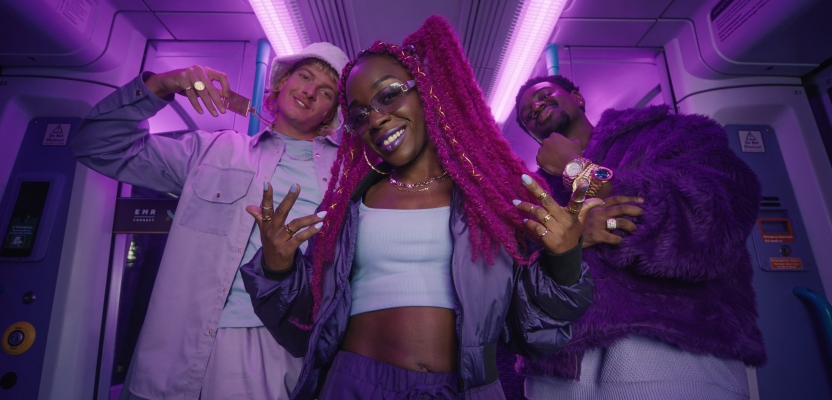

When East Midlands Railway (EMR) approached The Leith Agency with a brief to combat misconceptions about their Luton Airport Express service, creatives Neil Mackinnon (Copywriter) and Debbie Morgan (Art Director) knew they needed something bold. The result? A noughties grime-inspired campaign that remixes So Solid Crew’s iconic 21 Seconds into a hilarious and memorable anthem, “32 Minutes to Go.”
With a tight timeline and a competitive pitch process, the team leaned into a wildcard idea that blended authenticity, humour, and a nod to London’s music scene—delivering a campaign that’s as quick on its feet as the train itself.
We caught up with Neil and Debbie to learn more.
What was the brief?
The problem that the EMR (East Midlands Railway) team were facing was misinformation about the service. Primarily, how long the journey would take. People were under the impression that it would take 1-1.5 hours to get from St. Pancras to Luton Airport when actually the express service will get you there in 32 minutes.
So the brief was pretty clear, to let people know that the Luton Airport Express is an affordable, frequent and, above all, quick way to travel.
How did the initial pitch/brainstorming phase go?
The pitch process was pretty competitive. Our agency was part of a framework of 4 or 5 others all vying for the project.
We had explored quite a lot of different strategies to answer the brief, which made it tricky to think of where to go next. However, what we originally saw as a challenge we started to see as an opportunity.
Seeing as we had explored some pretty logical ways of answering the brief, why not try a wildcard. When we pitched 32 Minutes to Go, it was definitely the wildcard of the bunch and it turned out to be the right way to go.
What was the process behind ideating the concept?
Sometimes a brief’s simplicity can be a challenge in itself. The aim was to land a pretty straightforward message: this is a very quick, reliable and affordable service. However, that’s not far off what many other London Airport Express services are saying too.
Now, it only seems fair and in the interest of full disclosure to admit that there were a few stumbling blocks. We knew we wanted to explore music as a way of taking a simple message and making it memorable, but we didn’t initially land in the world of noughties grime music.
There may or may not have been a train themed rendition of “Oklahoma!” performed enthusiastically to a very quiet audience. But we had to falter to get somewhere. In the same meeting, we floated the idea of rewriting 21 Seconds by the So Solid Crew, which got a much better reaction.
The best thing about this process was the single-mindedness of it all. Once the team had bought into the 32 Minute song idea, everyone really got behind it, from strategy to client services to production. This enthusiasm carried us through the pitch process and thankfully the EMR team were fully on board.
What was the production process like?
Leith’s in-house production company, Leith Studios (special thanks to Producer Jennifer Howells), took on the seemingly insurmountable task of getting this campaign live in a matter of months.
In a lot of ways, this was more like making a music video than an advert, so we decided early that we wanted a talented music video director to take the helm. We knew that getting under the skin of the grime scene would be key in making it feel authentic, which is where the comedy could then stem from.
Enter Director Carly Cussen, who started her career in the London Grime scene working with the likes of Stefflon Don, Lethal Bizzle, Becky Hill and Sabrina Carpenter.
We would be lying if we said it was all smooth sailing but it was a staggering amount of team effort to get it over the line. What was really encouraging was the sense of collaboration across the board: from the trust of the EMR team, to the hard-working and talented Leith/Leith Studios team and the steady hand of a seasoned music video director.
What was the biggest challenge during production? How did you overcome it?
First of all - Time. Just like the Luton Airport Express, this process moved pretty rapidly.
We overcame the quick turnaround by working quickly, efficiently and staying adaptable. For example, we worked very collaboratively with Director Carly. We would jump on calls for quick decisions rather than going back and forth on email.
The same is true of the team at EMR, they constantly made themselves available for check-ins where we could get through various production questions/issues all at the same time.
Second of all - Place. We knew we wanted to shoot the ad from inside a train, while making it look really cool, with a heroic establishing shot from a train platform that doesn’t actually exist - easy peasy. The answer to how we achieved those things probably applies more to the next question.
What kit/tools/software were used to create the project?
To give the train interior and exterior the look we wanted we used a mix of practical and CG effects. We worked with Leith Cinematic Designer Chris Asquith, to create the opening hero shot of the train. Hero shot is exactly the word, we wanted to make the opener look and feel like a 00’s hip hop music video while also championing the Luton Airport Express train.
Working with Director of Photography Miguel Carmenes (who has both advertising and music video experience) we were able to light and style the train exactly like a music video. With a wealth of experience he was able to channel the 00’s hop hop vibe. With it being a train there were limitations and lots of challenges but with a lot of rewiring and lighting wizardry it ended up looking great.
What is one funny or notable thing that happened during production?
There were quite a lot to choose from, so I'll give you the top 3.
- Stacking three travel pillows on the neck of our female rapper, E.Z. Journeez, and the relief that it was actually going to work.
- Specifically the third rapper in the film, Lil’ Prices’ audition. He did some pretty unreal dancing straight off the bat. When our director Carly then asked him “Are you a dancer?” He replied with a Yorkshire twang “No, I’m a gardener”.
- When our female rapper, E.Z. Journeez, had to throw the kid’s bag into the overhead compartment, we thought it would take all day. She never missed once.
What’s the main message of this project and why does it matter?
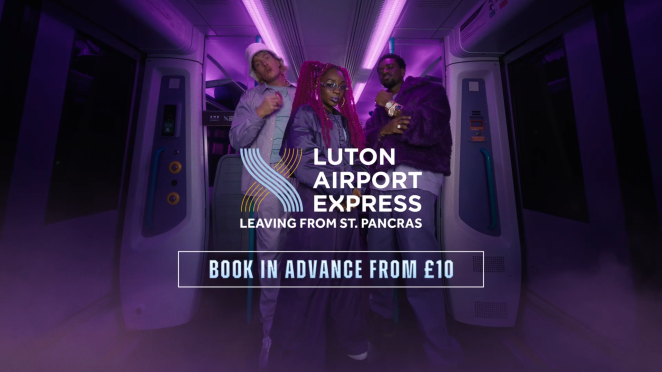
The main message is: 32 Minutes to Go from St.Pancras to Luton Airport.
It matters because it’s a very viable option for people that they may have written off due to being misinformed that it takes much longer than it does (1-1.5 hours)
How long did it take from inception to delivery?
Approx 4 months.
Can you describe the creative spark or inspiration behind the initial concept? Was there a specific moment or insight that ignited the idea?
When trying to land a straightforward message like “This express train only takes 32 minutes” it can help to take a bit of a break away from painstakingly trying to think of exactly the right strategy that’s going to hit home that message.
Instead, it became about finding the most memorable way to hit home a simple message.
Straightforward thought. Crazy concept.
That was the spark that opened this idea up for us. We thought: “Wouldn’t it be funny if people were singing about getting the train?” then it became “Wouldn’t it be funny if people were rapping about getting the train?”.
Finding that tension between the train world and the rap world was where the idea started to really take shape.
How did you ensure that the concept aligned with the brand's values, goals, and target audience?
Our primary focus for this concept was making sure it aligned with Luton Airport Express’ goals of better brand recognition as well as correcting misinformation about journey times. It also felt like a great opportunity to help them further define the brand too, establishing them as a fun, punchy alternative in the more corporate train world.
In terms of the target audience, 21 Seconds to go was big everywhere but nowhere more so than the London grime scene. That’s why this track fit so well for an ad targeted primarily at the Greater London Area.
Were there any alternative concepts or ideas considered during the ideation phase? If so, what led to the selection of the final concept?
We presented four concepts originally. Three slightly less out there ideas and our wildcard noughties rap.
We reckon that they chose the wildcard because it was just that. The team at EMR had seen so many different pitches by the time we presented, so we felt that more of the same probably wouldn’t hit the spot.
The other ideas were parked pretty quickly and luckily the whole team got behind “32 Minutes”, which was key to winning the work in the end.
Can you discuss any collaborative or interdisciplinary aspects of the ideation process, such as working with other departments or external partners?
As this was a very musically led project, we worked closely with two sound engineering companies, GAS (Manchester) and Finiflex (Edinburgh).
Sound is always carefully considered in any ad, but this was a whole different level. Both sound engineering teams were crucial in helping us do So Solid’s anthem justice to a t…t-t-t.

We also worked closely with Director Carly Cussen. The process felt very collaborative from the get go and it felt like each of us understood what we could bring to the table and what we couldn’t.
Carly’s vast experience meant we had access to everything 00’s grime culture at any time. She brought tons of enthusiasm and a really clear vision from the start. Where we came in on the creative side was finding the moments of humour throughout the film and keeping it on track tonally.
What role did consumer research or market analysis play in shaping the concept and its execution?
Head of Strategy at Leith, Vic Milne, was very thorough with testing, even at the pitch process. We wanted to prove at an early stage that this concept would elicit the response we wanted it to.
Once the ad had actually been made Vic made sure we were on top of putting it through meaningful market research, primarily System 1, where the film chalked up an “Exceptional” 5.6 star rating.
Can you discuss any unique or unconventional production techniques or approaches used to bring the idea to life?
Instead of having the performers rap on film, we chose to record the song in a studio prior to the shoot and then have the crew mime along to the music on set. This was a choice made early in the process on the advice of our Director Carly and it really paid off. It allowed us to get exactly the cadence and rhythm we wanted in place ahead of the actual shoot and made storyboarding the film to the exact timings much easier.
A slightly more lo-fi technical effect we used was: when you see the travel pillow land on the female rapper's neck that’s actually shot in reverse. No one’s aim is that good.
How did you ensure that the concept remained innovative and stood out in a crowded marketplace?
We knew that covering a song like 21 Seconds would garner some automatic attention, but we think it’s the tone and humour of the campaign that will help it to really stand out.
The world of train advertising can be quite samey. Sometimes heartfelt, sometimes a wry smile, always a bit corporate. We wanted to make something loud, funny, direct and a bit mad that would stop you in your tracks and have you rapping along - even if it’s against your better judgement.
What do you hope it achieves for the brand?
The Luton Airport Express is a relatively new train on the block. We hope that this ad gives the brand some cutthrough and possibly even street cred in a crowded market.
On a personal level, we hope people rewrite their own lyrics in their head, yo.
Credit list for the work?
EMR Team: Jenna Cowie, Natalie Sanderson and Matt Whitehead
Director: Carly Cussen
Creatives: Debbie Morgan and Neil Mackinnon
Creative Directors: Troy Farnworth and Phil Evans
Production: Jennifer Howells and Amber Hooker
Strategy: Victoria Milne
Editor: Daniel Austin
Client Services: Ed Brooke, Beth Lauder and Lucy Allison
Studio: Stuart Whibley, Steve Milne and Chris Asquith