

In this exclusive interview with, we sit down with Pete Champion, Partner and Group Creative Strategy Director at I-AM, to delve into the dynamic world of creative strategy. With nearly three decades of experience in leading one of the most innovative agencies, Pete shares insights on what it takes to stay ahead in the ever-evolving design landscape.
From his nature-inspired roots to co-founding I-AM, Pete’s journey is a testament to the power of combining logic with creativity. Join us as we explore his unique perspective on the future of the industry, the importance of human connection in design, and the lessons learned from a career defined by passion and relentless positivity.
Tell us a bit about your role! Is there a “typical” day?
Fortunately, for how I’m wired, it’s a somewhat atypical existence we lead. The sheer diversity of daily experiences, challenges, joys and happenings here, are what’s kept me probably a little too devoted to this thing called I-AM since we started it.
My role, overall, is about making sure clients get what they need (and beyond). Solving briefs while amplifying and seizing opportunities. The focus of my role is to develop powerful creative strategies as frameworks, based on key principles fundamental to our creation of concepts, for people inspired experiences. Design is logic plus magic, and I’m here to ensure we get the perfect blend of the two, to achieve positive impacts on clients’ businesses.
My I-AM life includes meeting (and hopefully inspiring) new potential clients and agreeing on terms for working together. After creating the strategic ‘WHY’ principles described above (driven by design research we conduct), I’ll work with my partners, directors, and design teams on the ‘WHAT’ concepts, and then a little classic creative director shoulder-surfing on our teams’ work on the ‘HOW’ (developed concept proposals and detailed design).
I co-present work alongside our brilliant teams, help build long-term client relationships, and work to make sure our achievements get the response and recognition they deserve.
Tuesdays to Thursdays are when the fun really happens, because we’re together in our gorgeous space on top of a historic ex-school building at Rochelle, Shoreditch. These could involve almost anything from creative project catch-ups, preparing and hosting workshops with clients, presenting with the team, or working on I-AM with my partners and directors.
Mondays and Fridays are spent at-home, where I use the time for quieter tasks like catching up on emails, thinking, writing, sketching and general individual flights of fancy to bounce off the team.
What was the biggest challenge in getting to your current position?
Having met our Group MD Jon, as my first ‘interviewer’ after graduation, I’ve been lucky that our paths to today were woven together from the start and we founded I-AM as two of the original partners.
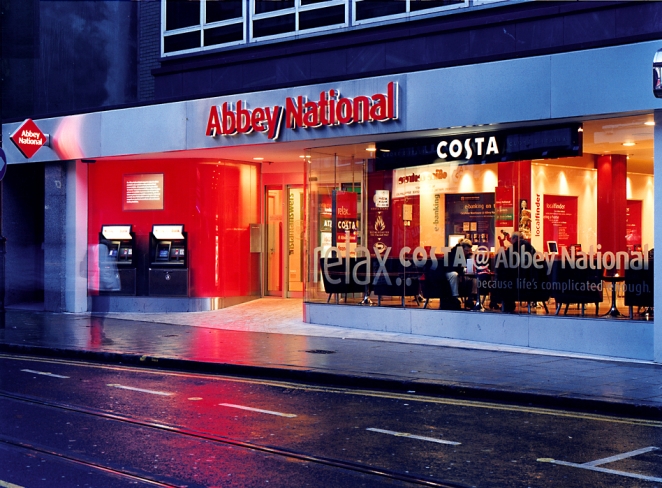
Abbey National by I-AM
So, challenges have tended to be more external, and (thankfully) shared. Building, sustaining and growing an independent agency through the ‘market volatility’ over our nearly 30 years has required every ounce of belief and ‘relentless positivity’.
Being tuned into change and adapting to it, learning financial rigour (and painful lessons), never taking inflow of business for granted and weathering the inevitable dips in fortune – all this is the hardest work. We do this for love and money (in that order) – the love comes easy, the money is always the biggest challenge.
What is your personal background and what role did it play in your career?
I’m a nature boy at heart. As a kid I was a regular little Gerald Durrell; my bedroom was basically a zoo. My relationship with the natural world developed through drawing, illustration and art, while I learned the power of verbal communication through teenage summer stints as one of those guys who does talks at The Sea Life Centre - this later served me well in presenting and explaining concepts.
In deciding my life direction, I needed a purpose for both my scientific mind and creative spirit. The epiphany came on my foundation course, saving me from becoming a distinctly below-par marine biologist, and propelling me into 3D Design. My subsequent product design training informed my user-centric approach to spatial and experience design, which has dovetailed with a developing fascination with human nature.
My nature-grounded background perhaps shaped my strong conviction that human creativity (whether we plan it or not) strives to achieve the kind of ‘right-ness’ we innately feel in the wonders of nature. My career has grown out of my ability to combine rigour and structure with creative imagination and a joy of celebrating all this in the ways I describe it.
What is your biggest career-related win? What is your biggest loss?
The game-changer for us was when, as an embryonic new agency, we somehow got involved in a huge bid back around the year 2000 to completely re-think and redesign the branch experience for Abbey National (now Santander).
The team there were completely visionary in what they are exploring about how a banking space might actually be designed as a nice place to spend time, with a Costa Coffee inside and oriented around customer needs (crazy stuff, right?). We really blew them away with our thinking and beat the (then) mighty Fitch to the win, it became our springboard into the realm we now inhabit, of disruptive innovation in design for financial brand experience around the world.
Loss-wise, we pretty much landed a near-ultimate brief for one of the world’s most famous soft drinks brands – the most incredible project to manifest the product and brand attributes as a super large-scale flagship immersive multi-sensory experience. Just as it was about to kick off, good old Covid came along and the whole thing literally poured away from us.
Which individuals and/or agencies do you gain inspiration from? Do you have any heroes in the industry?
It’ll sound too cheesy to say my heroes are my team, so despite the fact this is true, I’ll come up with some external references. As we started out in high street retail, our early inspirations would have been Rodney Fitch and especially Terence Conran, and later Ingvar Kamprad, founder of IKEA.
They changed the UK’s sensibilities on great design, expanding its reach beyond the preserve of the privileged few. My product design hero is of course Jonny Ive, who in Apple’s most seminal time was the design wind beneath Steve Jobs’ visionary wings.
What advice would you give to your younger self?
Don’t let other views on your future path, override where your heart wants to go. As a kid with my seemingly opposing interests of science & nature vs art & creativity, there was much well-intentioned but uninformed urging towards the ‘respectability’ of science (where I might have become at best an average biologist or a positively dangerous vet).
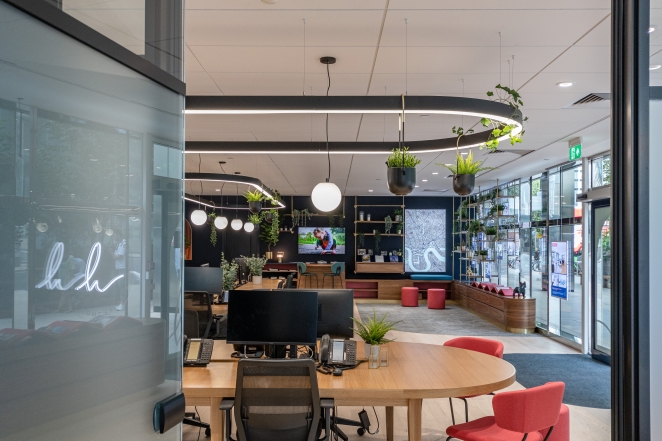
Jon Hollands & Hamptons
Fortunately, a timely nudge from a great art teacher led to a gap year doing Foundation Art & Design that saw my epiphany during a lecture on ‘Industrial Design’, which genuinely changed my life direction.
If you weren’t in your current industry, what would you be doing?
Wonderful as this field has been to me, it has sadly deprived the world of one of the greatest bands that never quite hit the big time, in which I still play lead guitar from time to time. The Sid James Experience (check the contemporary name) has rocked many a gathering but seems unlikely ever to play Wembley.
What’s your one big dream for the future of the industry?
That it doesn’t let the machine override the human. People first, tech in service of human connection, wonder, joy, imagination, vision. An enabler not a driver of what it is that makes us people. And that in doing this we use creativity to put all these features of what makes us human, at the heart of addressing the wrongs we’ve done to our planet and driving a more sustainable future through desire and reward, not just duty and sacrifice.
What are your top tips for aspiring creative professionals?
Exploration and information lead to inspiration. But lead first and foremost with your own unique vision. Only you can bring that originality into the world.
Skill up, across all aspects of this job. Usefulness and range is value. Especially, learn to articulate. Across as many forms as possible: drawing, modelling (analogue and digital), but don’t forget talking. Explain the ‘why’ of what you do alongside the ‘what’ that you’ve created – this will reinforce your own belief and confidence, and make you convincing and trusted.
Positivity is everything. Personality and attitude that reflects this are the most fundamental personal qualities I seek in our people, over and above everything else.
What are your top tips for other creative leaders?
Set an example of positivity. The power of the inspiration our example can set, can push real improvements through inevitable challenges, and what we deliver when we and our clients get it right, genuinely improves lives.
Trust and empower those that we lead. Resist the urge to take back over. Create space for people to explore, experiment, make mistakes, learn and evolve.
Encourage a balance between (spaces and opportunities for) introverted, individual creativity, and what happens when that is multiplied by extroverted, group collaboration.
When you think about your team, what is the thing that matters to you the most?
To quote Kipling: ‘The strength of the pack is the wolf, and the strength of the wolf is the pack. I was lucky to grow up in a big, loving family, where in an unstable external context (my dad was in the RAF so we moved a lot), ‘together’ came to be a powerful idea to me.
At I-AM we are what I’d call ‘hyper normal’ with each other – this is life as well as work, and that shared belief seems to have fostered an emotional bond of shared endeavour. That spirit of kinship and being a collective, matters to me above all else I’d say.
How do you approach collaboration with other creatives or teams and what do you believe makes for successful partnerships?
Too much ego can quickly become toxic, so it helps for everyone to keep those in check. Clarity of purpose and alignment around a shared goal right from the outset is essential, as well as good organisation and planning, dividing forces according to best ‘special skills’.
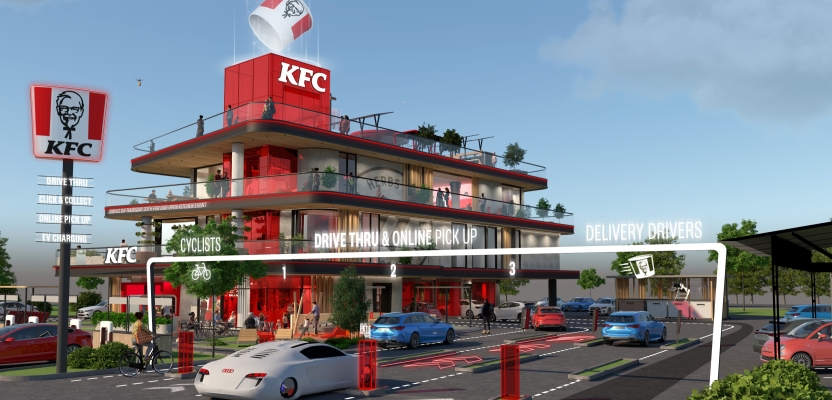
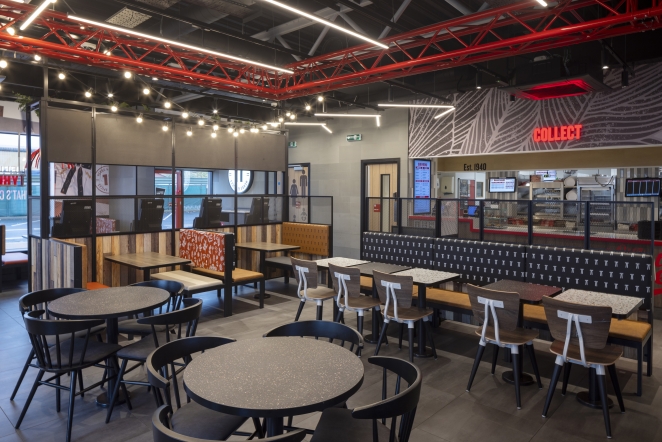
Working in increments while trusting an iterative process, combined with open communication, can lead to really powerful collaborations, like the award-winning KFC of the Future Virtual Reality experience we created with partners Circus.
What industry trends do you foresee taking hold in the coming months?
We’re exploring a lot on ‘hybrid’ experiences right now. This builds on the idea of ‘fluidity’, which we did a study on last year. Coming out of this, there’s exciting potential for lot of ‘Co-’ s: Co-living, co-working, co-retail, co-hospitality... I should Co-co.
This blending together of functions into co-located, integrated experiences facilitates, encourages and reacts to new behaviours and can spark some very cool potential for design.
What do you think sets apart truly exceptional creatives from the rest of the pack?
Open-mindedness and bravery. They stick their head above the parapet when others play it safe, and they play instead of (or as well as) work. They’ll be interested in what’s developing around them, but they start inside themselves before using external references. They challenge accepted wisdom and logic. And they strive for that most uniquely human thing: wonder.
How do you think technology has influenced the creative industries and how have you adapted to these changes?
It’s streamlined so much. In amazing and in some places not so good ways. I worry about the inevitable trend towards the loss of hand skills and craft in design, in the process of digitising the vast bulk of our process and output.
Jonathan Taylor from Cloud 9 photos & KFC
We’ve embraced it all while holding onto the post precious aspects of the ‘old ways’: the key as ever is the people more than the process and the tools. A mix of experienced heads with new generations, and a diversity of preferences, leads to a happy balance, and extraordinary quality of work delivered in the kind of timings that would have blown the minds of our younger selves.
How do you prioritise self-care and maintain a healthy work-life balance?
Well, the first thing is that I-AM is life, more than work for me anyway, so that’s a good start. It can get stressful from time to time, so my main self-care outlets are a ‘rural’ family life in the Surrey Hills (my love of nature remains strong, and I rather ridiculously as a design company co-owner do more sketching on holiday than in the studio).
Music and the band are also a key re-charger, alongside swimming, snooker with my son and throwing myself around a tennis court.
How do you handle creative blocks or burnout?
I just change the context I’m in on if I start to get too enmeshed in a particular challenge. A different perspective always works; this could be a chat about something else, a hit of London at its most vibrant, or a stroll – again, being in nature is usually the best source of right-ness and inspiration.
Can you describe a moment when you had to think outside the box to overcome a creative challenge?
I think we have to do this on every brief – for instance, the key to our work on Hamptons estate agents was to think outside in. You don’t start with what something is, you escape from all the accepted ‘givens’ or conventions and try ‘What if?’s: What if their proposition is about Home not property? What if their ‘offices’ were shared hospitality spaces more like a Hoxton hotel?
Do you have any websites, books or resources you would recommend?
My fascination in this area is not so much for the lovely design and architecture books (gorgeous as they are) and visual / design trends resources like Cool Hunter (useful as they can be). I think as designers we should embrace the fast-developing fields of psychology, behavioural economics and neuroscience, to understand how and why what we do, actually creates its positive effects on people.
So, book-wise: Nudge (Cass R. Sunstein and Richard H. Thaler), The Behaviour Business (Richard Chataway), Thinking Fast & Slow (Daniel Kahneman & Amos Tversky), Obliquity (John Kay), Predictably Irrational (Dan Ariely), Neuromarketing (Partrick Renvoise) and old classics such as The Experience Economy (Pine & Gilmore). Online, check out Rory Sutherland in particular, and listen to blogs like Talking Shop.