

From sketching machines as a curious child to shaping innovative hardware solutions with his Brussels-based studio Futurewave, Joachim Froment’s journey into design has always been driven by curiosity and invention. With a Master’s degree in Product Design from the Royal College of Art and early experience at Skibsted Ideation in Denmark, Joachim built a career that seamlessly bridges aesthetics and technology. His work spans mobility, furniture, lighting, and advanced hardware projects, always rooted in a balance between function, emotion, and form.
Today, as co-founder of Futurewave, Joachim continues to push boundaries at the intersection of design and technology, partnering with startups and global companies alike. His approach blends technical precision with intuitive creativity, producing products that are not only functional but poetic in their expression. For Joachim, design is about uncovering hidden beauty, creating clarity through complexity, and shaping ideas that resonate with both the mind and the senses.
How did you first get into the industry?
After earning a Master’s degree in Product Design at the Royal College of Art in London, I began my career as an industrial designer at Skibsted Ideation in Denmark. There, I worked on mobility projects for Biomega and developed furniture and lighting concepts for several Danish brands.
Later, I co-founded Futurewave with partners from the tech sector — an innovation agency focused on hardware products at the intersection of design and technology.
But my journey into design really began earlier — from a fascination with both drawing and science. I was always sketching, imagining systems, and exploring ideas through form. That curiosity led me to design as a way to bridge aesthetics with function, imagination with engineering.
Where are you based now and who do you work for?
I’m currently based in Brussels, where I run Futurewave — our innovation studio dedicated to hardware tech. We partner with companies of all sizes — from established corporations to early-stage startups — helping them bring meaningful and technically advanced products to life.
What is your personal background and what role did it play in your career?
Studying Industrial Design at La Cambre gave me a strong material foundation — understanding how things are made, how they behave. Later, at the RCA, my focus shifted toward vision: what kind of designer I wanted to be, what values I wanted to express through my work.
Growing up, I was always inventing. I’d design machines, sketch prototypes, imagine how things could work differently. That playful relationship with invention — often inspired by science — naturally evolved into a focus on innovation and tech products at Futurewave.
If you weren’t in your current industry, what would you be doing?
I’d probably still be inventing things — maybe building odd, poetic machines like Panamarenko, or exploring other creative industries like fashion or architecture. Something hands-on, curious, and conceptual.


Can you explain your creative process? What makes it unique?
My process sits at the crossroads between logic and intuition. I need to understand how things work technically, but I also design instinctively — thinking through drawing, modeling, and fast iteration.
I rely on generative design principles: test quickly, fail fast, de-risk early, and build with a multidisciplinary lens. I'm obsessed with creating systems and smart features that feel inevitable — intuitive to use and minimal in appearance, though often complex in their making.
How would you describe your style?
I blend industry with poetry.
My style tends to balance opposites: organic forms and minimal lines, emotional curves and mechanical logic. I aim for clarity in function but also emotional resonance in form — something that speaks to both the mind and the senses.
Which individuals do you gain inspiration from? Do you have any heroes in the industry?
Jony Ive, Ron Arad, and Sir Kenneth Grange have all shaped my thinking.
Meeting Kenneth Grange at RCA was a moment I won’t forget. Even in his late 80s, he was deeply curious, completely up to speed with emerging technologies, and still full of questions. That constant hunger to learn and explore — it’s something I admire immensely.
What tips would you give to aspiring creatives looking for work?
Stay curious — not just in design, but in everything around you. Be practical, but don’t let go of your instincts. Creativity often comes from lived experience and emotion, not just logic or theory.
What tips would you give to other professionals to get more clients?
Do the work with real care and conviction. People can tell when you’re deeply invested — and that’s what builds trust. Also: value relationships. Great clients often come from long-term, human connections.
Can you share a memorable experience from your career that shaped your approach to creativity?
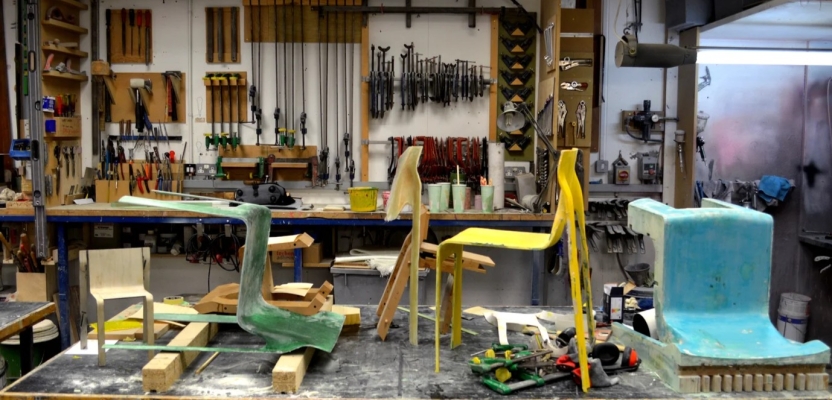
One defining experience was while developing the 0.6 Chair during my time at RCA. I worked with Windsor Workshop and tried to merge carbon fibre with wood veneer using a hand lay-up technique. I failed again and again — but finally cracked it. That process taught me a lot about persistence, material storytelling, and the beauty of unconventional combinations.

What kind of tools/kit/software could you not do without?
For creativity: paper, pencil, blue pencil, and a good eraser.
For 3D work: Rhino and SolidWorks — essential for both sculptural exploration and technical integration. 3D printing is also key for fast prototyping.
For speed and ideation: AI tools like Sora or Magnific AI help visualize ideas quickly, often in combination with sketching and Photoshop.
What’s your secret to staying inspired and motivated?
Reconnecting with your personal “why.” When you know what drives you — what matters — it keeps you grounded and energized, even when things get messy.
What’s the work achievement you’re most proud of?
Each project has shaped me in some way, but a few standouts are:
- The 0.6 Chair
- The Knit Lamp
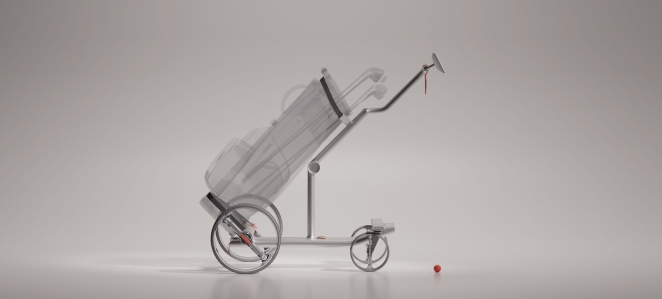
- The IXI Golf Trolley
- And a recent (confidential) EEG medical device — a very technical, collaborative, and meaningful project.
As someone with experience in the industry, what trends do you foresee shaping the future of creativity?
Greater integration between design, engineering, and strategy — from the very beginning of a product journey. Cross-functional collaboration isn’t just a trend; it’s becoming essential for innovation.
What do you think sets apart truly exceptional creatives from the rest of the pack?
A mix of humility and relentless curiosity. Exceptional creatives stay open — always questioning, observing, learning. They notice things others miss and see opportunities in the in-between spaces.
How do you think technology has influenced the creative industries and how have you adapted to these changes?
Technology has amplified what’s possible — we can prototype faster, visualize quicker, and access more tools than ever. But it’s important to remember: tools don’t replace vision. AI is useful for speed and generation, but real design requires context, emotion, and perspective.
What is the one thing that you would change about the industry?
I’d love to see more room for experimentation in commercial contexts. Too often, projects are driven by efficiency and speed, leaving little space for depth, exploration, or meaningful risk-taking.
Any websites, books or resources you would recommend?
Wabi Sabi
Emotionally Durable Design by Jonathan Chapman
Design Emergency by Alice Rawsthorn & Paola Antonelli