

Artificial intelligence is changing the creative industry at an unprecedented pace, but for many leading agencies, the real competitive advantage isn't automation—it's originality. As AI becomes increasingly accessible, the challenge is no longer adopting new tools, but creating brands that remain distinctive in a world where everyone has access to the same technology.
In this Q&A, Joseph Hedges, CEO, Creative Director and Founder of Branding by garden, shares how the agency has built iconic brands through strategic thinking, human creativity, and a culture of experimentation. From the opportunities and limitations of AI to the role of play, branding, and innovation, he explains why the future belongs to businesses that use technology to enhance creativity rather than replace it.
How was your company born and where are you based?
Garden grew out of East London in June 2010, driven by a desire to colour the world through branding, packaging design, and retail environments. Having already worked for many large branding consultancies and design agencies, and having run multiple departments within them, I wanted to create a branding consultancy that understood and explored branding beyond a logo and colour palette. I wanted to merge movement, sound, environment, texture, scent, taste, everything that people experience. Hence the name Garden; we wanted to conjure up a place that brought all these elements together and inspired people.
What was the biggest challenge to the growth of your company?
 There are many challenges, but one that comes up repeatedly is the misconception around AI and what it can genuinely deliver.
Many clients arrive with exaggerated expectations and little understanding of how to actually benefit from it. We began integrating AI into our own workflow around two years ago, initially using it to analyse brand sentiment, and it is powerful when applied in the right places. But as even AI systems themselves acknowledge, they rely on large datasets. Creativity and originality don't emerge from large datasets. They come from small, nuanced ones - humans. That tension isn't going away any time soon, and for now, a significant part of our job is simply educating clients on what AI can and cannot do for their brand.
The deeper challenge, though, is what happens next. Right now, AI has levelled the playing field. Every company has access to the same tools, the same efficiencies, the same outputs. And when everyone is competing with identical advantages, those advantages become meaningless. Differentiation disappears.
What that creates, and I find this genuinely interesting, is a growing opportunity for brands that are willing to lean into creativity, originality and human expression. Because if your competitors have the same tools, the same data and the same capabilities, the only meaningful edge left is your brand. How distinctive it is. How human it feels. How impossible it is to confuse with anyone else.
I'm already seeing the smarter brands respond to this. They're pushing harder on brand expression and positioning rather than competing on the same tired ground. Look at something like SKIMS new store interior, bold, distinctive, visually fearless. That's not a coincidence. That's a brand understanding that in a world where everything is starting to look and feel the same, the ones that stand out are the ones brave enough to be genuinely different.
That, to me, is the real challenge right now, and the real opportunity.
Which was the first huge success that you can remember?
When we rebranded Sainsbury’s Tu, we demonstrated how strategically directing a brand can significantly boost revenue and overall business success. The power of understanding every detail, positioning a brand within a specific demographic, refining product ranges, and realigning the brand, helps consumers grasp its value and purpose. This, in turn, builds connections, strengthens recall, and drives long-term growth.
Sainsbury’s Tu was a huge success, with the rebrand increasing profits by as much as 15% and growing at three times the rate of their food business, proving the impact of strategic branding beyond just a logo.
What’s the biggest opportunity for you and your company in the next year?
 Clearly communicating our position on AI to our peers and clients.
Garden occupies a rare and genuinely distinctive position in the UK branding market. The agency combines the strategic rigour and portfolio depth of a large consultancy with the creative invention, agility, and human accountability of an independent studio. Garden have built brands that are national icons, turned failing businesses around, and created identities that have stood the test of time across dozens of sectors and continents.
Eurotunnel moved from red to black. Sainsbury’s Tu became the UK’s second largest fashion brand. ENOC won Superbrand status three consecutive years.
But Garden is not simply experienced. It holds a clear and emerging point of view: in a world increasingly drowning in AI-generated sameness, the most powerful brands are made by humans who use technology as a tool, not a crutch. Human experience, Instinct, invention, play and genuine creative courage are what Garden brings.
These cannot be prompted.
Can you explain your team’s creative process? What makes it unique?
We devised our process many years ago, 25 years ago, in fact, when I first developed our methodology. Over the years, it has remained largely consistent, with some evolution in certain areas. Essentially, we follow a three-stage design process that incorporates client knowledge, benchmarking, market gap analysis, customer insights, and stakeholder vision (we call this K-lab). This then feeds into a strategy that defines mission, vision, values, purpose, proposition, and market gap analysis.
Once we have established the target, we move through a three-stage design process, starting with broad exploration before refining concepts for testing and trademark searches. While this may sound functional, after 25 years of experimenting with different approaches, this method has consistently proven to be the most successful.
The creative aspect of this process is explored in different ways, but our understanding of AI, or rather how to use it, is now one of our biggest strengths. The secret…Remain human. Learning through play and making mistakes that AI can never do. Having conviction in the decisions we make now and knowing when to bring in tech to aid the process, always ensuring it is used to aid us rather than lead us.
How does your team remain inspired and motivated?
 I believe from my own experience, that there are only two ways to create unique but relevant work, one is inspiration from what’s been before and what we can see around us, the other is play. Experience tells us what is acceptable and all things around us can inspire us, but play brings surprises and mistakes, and that can lead to new ideas, therefore for me, play is the best approach to idea generation, and play in-itself can be inspiring.
What is one tip that you would give to other agencies looking to grow?
Curiosity + play = origination, which in turn creates growth.
What’s your one big hope for the future of the industry?
That the industry will continue to lead through years of experience that AI will never be able to truly replicate. To continue to search for the original, the unexpected and to inspire the next generation of designers out there looking for their big break and get a foot in the door.
Can you share a defining moment in your company's journey that shaped its identity or direction?
 Honestly, I think 2026 is going to be a big year for us. We are rebranding, launching a new website and going for business growth in a way that we have never done before. It’s an exciting time for us.
How do you foster a culture of innovation and experimentation within your team?
Experience tells us that yes, things around us can inspire us, but play brings surprises and mistakes, and that can lead to new ideas, therefore for me, play is the best approach to idea generation, and play in-itself can be inspiring.
What measures do you take to ensure diversity and inclusion are prioritised within your company?
 We operate as a fully remote team, and that decision, which was about finding the best creative and strategic talent wherever it lives, has naturally produced something that a traditional office model rarely achieves. Our team is globally distributed, genuinely culturally diverse, and brings a nuanced understanding of the different markets, audiences and cultural contexts we work within every day and we see this as our competitive advantage.
We have clients across multiple countries and sectors. One of the most consistent challenges we help them navigate is the assumption that what works at home will travel. It almost never does without significant adaptation, whether that is tone of voice, visual language, purpose, distribution, or the way a product is even stored and presented. Having a team that understands that instinctively, from lived experience rather than research alone, changes the quality of the thinking.
Beyond geography, we are proud of our gender balance, which sits at roughly equal, with a slight lean toward more women than men. We are also a team that includes a significant number of working parents, and the remote model supports that in ways that matter. It allows new mothers flexibility in how they return to work. It removes the false choice between professional ambition and the reality of family life. It means talent we would have lost to a rigid nine-to-five stays with us, and the work is better for it.
Diversity at Garden is not something we have to think about. It is simply part of who we are.
Can you describe a project that challenged your team creatively and how you overcame any obstacles?
 Mollie's is probably the best example I can give you, and it comes in two parts.
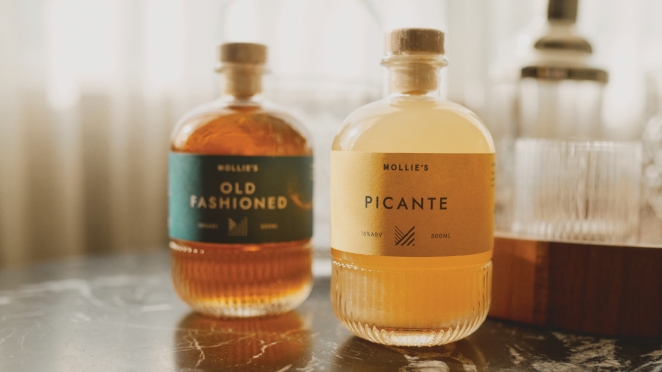
The first challenge was the original rebrand. Mollie's was a genuinely new category, not a motel, not a diner, something in between that the market had never quite seen before. We won the project in a five-way pitch against some of the UK's largest agencies and built a brand from scratch that went on to outperform competitors with hundreds of locations and decades in market. Two sites, 74.5K Instagram followers. That does not happen by accident. It happens because the creative thinking was specific, honest and genuinely distinctive.
The second challenge was harder in a different way. When Mollie's acquired Granada Studios in Manchester, the brand suddenly needed to stretch from roadside journey pause to city-centre destination, speaking to a completely different audience without losing what had made it work in the first place. Several agencies had touched the brand in the intervening years and the cumulative effect had begun to dilute it. Our job was to go back in, establish what to protect and what to evolve, and refresh the entire brand system with the confidence that comes from having built it originally.
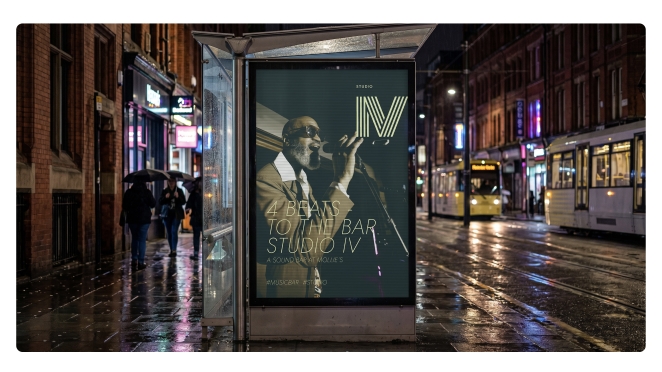
Out of that came Studio IV, the music bar inside Granada Studios, which needed to function as its own independent brand with genuine cultural credibility, rooted in the heritage of the building and the visual language of 1970s television and film, while maintaining a quiet, deliberate relationship with Mollie's. Getting that balance right, distinct enough to stand alone, connected enough to make sense within the family, was a genuinely interesting creative problem.
Do you have any websites, books or resources that you would recommend?
Our own website. Refreshed. Reinvested. And launching Q2 2026…watch this space!