
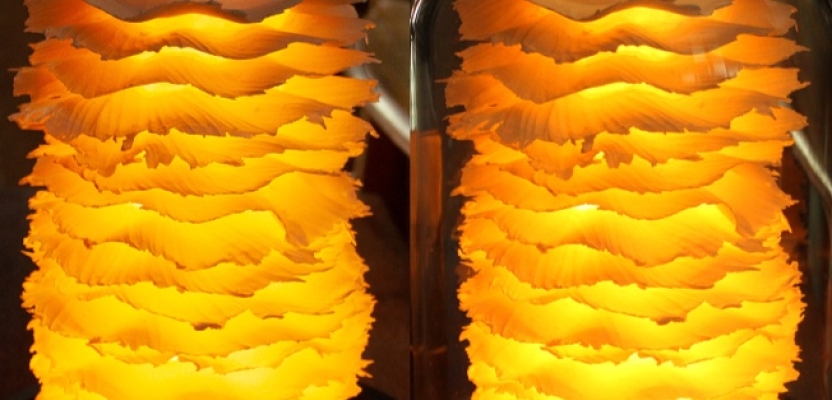

Rich Land’s creative journey has always been about balancing opposites—analogue and digital, chaos and control, ancient craft and cutting-edge technology. After decades in the digital creative industries, Rich made the leap back to hands-on making, founding his studio Possible Shapes in 2024 to explore the sculptural potential of clay and light.
Working from his home studio in North London, he combines translucent porcelain and earthy terracotta with 3D-printed precision tools, creating lighting pieces that feel both natural and otherworldly. Each work carries the unpredictability of fire and clay, yet also the refined intention of a designer trained in architecture and design research. The result is a body of work that glows (literally) with innovation, risk, and a passion for materials pushed to their limits.
How did you first get into the industry?
About five years ago I made the decision to switch out of a career in the creative digital industry in order to focus entirely on developing a design and build practice aimed at creating innovative sculptural lighting combining hand building ceramics with some of my technical and digital skills.
After taking numerous ceramics courses and establishing a studio in London, I set up a new business, ‘Possible Shapes’ at the beginning of 2024. I set up a studio in my house with tools including a kiln, a potters wheel and 3D printer and began developing an increasing range of sculptural lighting products - made from materials such as ultra-thin, translucent porcelain and earthy, unglazed terracotta and inspired by the fractal-like chaotic structures found in natural forms.
Where are you based now and who do you work for?
I have a fully equipped studio in my house in Tufnell Park in North London. I work for myself on development of various art and functional pieces and I’m currently working on a number of commissions that involve customised designs.
What is your personal background and what role did it play in your career?
After graduating with a degree in Architecture at the Bartlett School of Architecture and then a masters in Design Research from the Royal College of Art, I set up a studio in Camden Town call ‘I.E’ in the late 1980’s – working at the interface between the analogue and the digital – to create experimental interactive art.
Following that I pursued a career for many years in the creative digital space, working for entertainment, cultural/heritage and advertising industries. Although projects I worked had a creative element, my role was increasingly managing teams.
Also, as the industry lent ever more heavily on social media and influencers, projects become less about inventive applications of interactivity.
I began to yearn for a more hands-on and visceral form of creativity and, after some exploration and experimentation, I discovered fascinating potential that came from combining translucent porcelain and light.
If you weren’t in your current industry, what would you be doing?
I may have returned to my earlier practice when I was experimenting with and creating interactive installations using digital technology. So much more is possible with current technology than the rudimentary equipment available to me in the 1980s!
Can you explain your creative process? What makes it unique?
My working method merges the ancient with the modern. I combine clay using materials and techniques that have been developed over millennia with 3D printing using materials and techniques that have only been developed in the last decade.
Both express ideas in a physical, three-dimensional form. Clay is, by its nature, unpredictable, messy and requires manual effort and dexterity. By contrast, 3D printing is about precision, predictable outcomes and requires abstraction and screen-based manipulation.
The two modes of working are complementary (and both are essential to my creative process) and they each satisfy different facets of my creative interest. You could consider the 3D printed models (that I use to create molds and tools) as the precise genotypes – the perfect seeds that represent the idealised forms.
Once these virtual forms are expressed in clay – in the real-world – subject to forces of nature and the elements: earth, water, air and fire and squeezed, kneeded and pulled in my hands, they take on a dynamic life of their own that makes each piece unique. Clay always presents a degree of risk: I open the kiln after a 30 hour firing and cooling cycle with a mixture of anticipation and anxiety.
How would you describe your style?
A common thread in my work is complex, naturalistic forms using a very minimal palette of materials. The majority of pieces are formed mainly of two clays: porcelain and terracotta. Of course, as lighting, they also contain a variety of modern materials for their electrical and electronic functions.
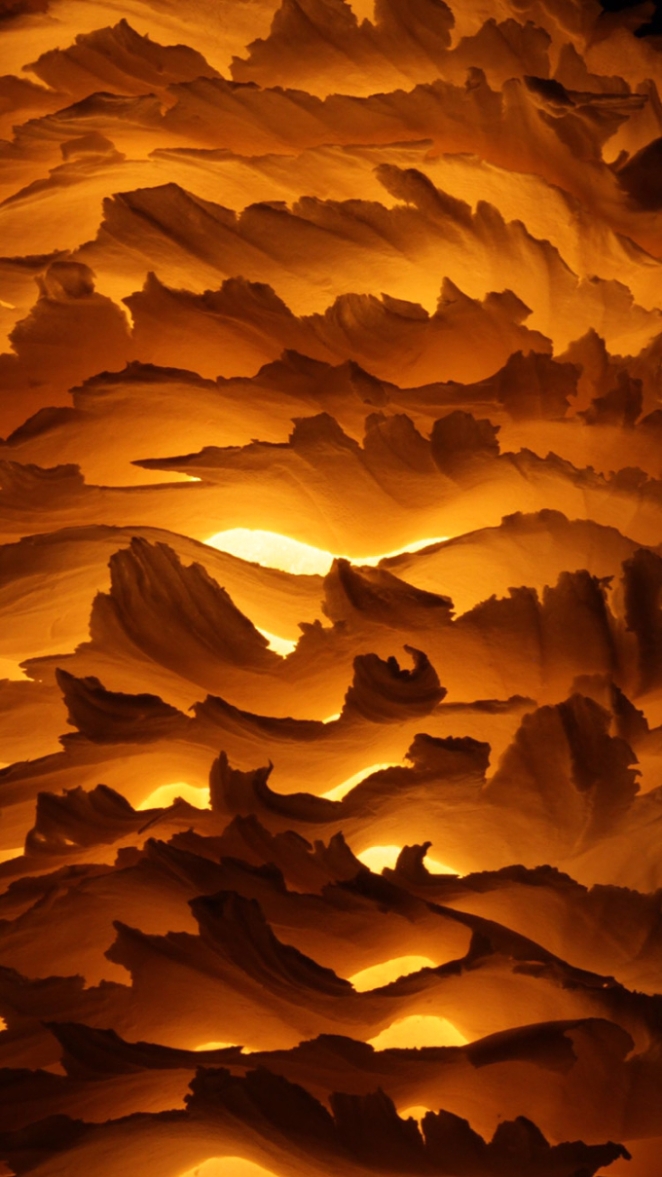
Stylistically, I aim to create forms that are intriguing and beautiful in themselves but that go through a transformation when lit up.
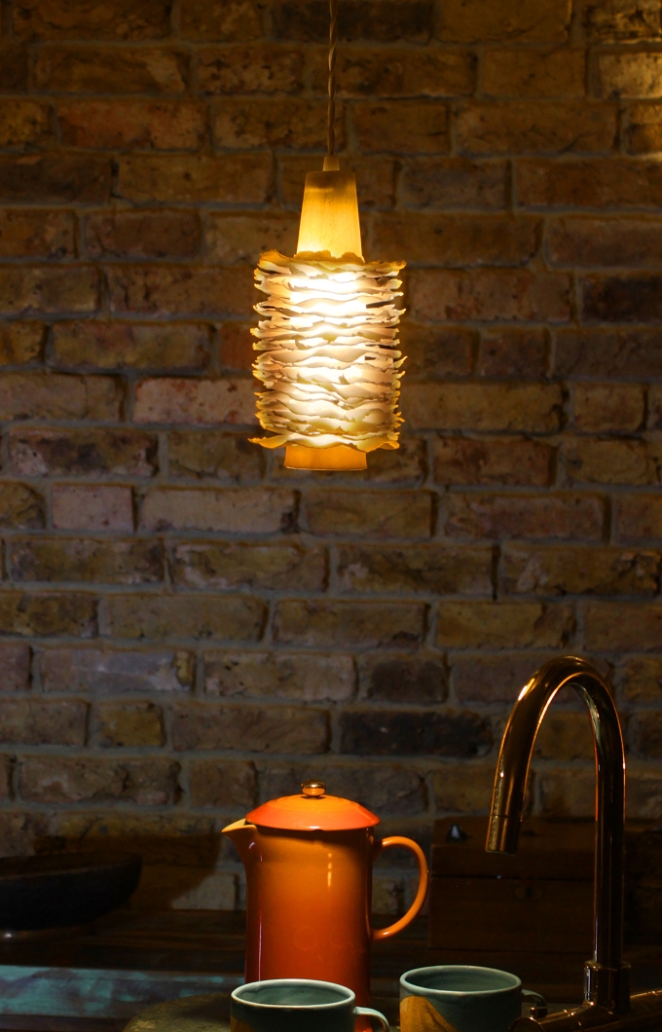
The sculptural forms take on an internal energy that invites the viewer’s gaze much as a fire does and, at the same time, they shed a light that invokes warmth and calm.
So the other major factor in their overall style is their relationship to light. A considerable amount of time and effort is involved in calibrating the way the light transmits through the porcelain and spills onto surfaces via carefully positioned spaces and openings.
Which individuals do you gain inspiration from? Do you have any heroes in the industry?
The epic naturalistic works Andy Goldsworthy and Richard Long have always inspired me.
I like the explorations of materials like wood and copper by Heechan Kim and specifically in lighting the naturalistic work Jean-Gabriel Neukomm who uses mica to great effect and Margaret O’Rourke who has been making great use of the translucency of porcelain in lighting for much longer than me.
What tips would you give to aspiring creatives looking for work?
Try to have self-belief. Be ready for knock-backs. Be prepared for a long slog.
What tips would you give to other professionals to get more clients?
Offer/gift pieces of your work to people. You never know what doors that may open. Be prepared to talk about and show your work, even if that is a bit embarrassing.
Can you share a memorable experience from your career journey that shaped your approach to creativity?
Whilst experimenting with clay forms in a ceramics class, I’d been interested in trying to stretch out various clays as thinly as possible. My tutor suggested I try porcelain because of its particular strength and plasticity. Once my test piece was fired, I could see that it had a translucent quality.
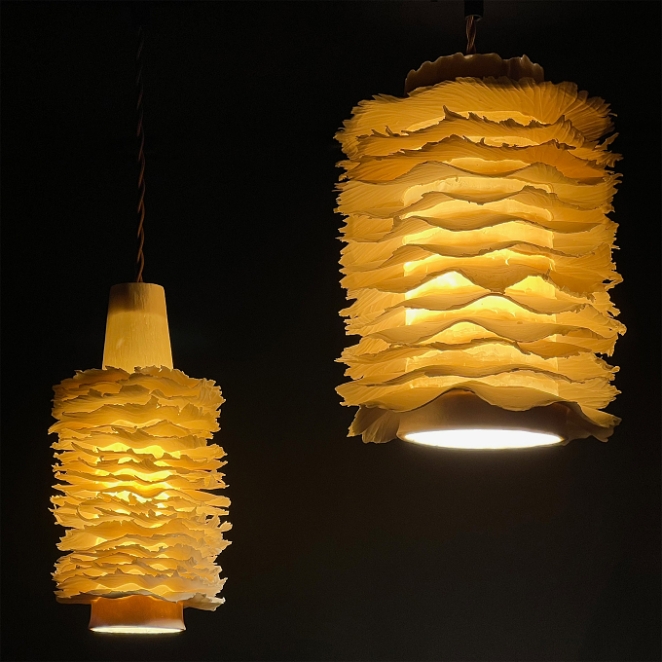
But it was when I aimed my iPhone torch into that I saw the light (literally)! My crudely made porcelain bowl was transformed. It glowed in a way that expressed every movement my fingers had made on the clay and the light it emitted had a warm, ethereal glow. From that point I was determined to design a develop sculptural lighting.
What kind of tools/kit/software could you not do without?
I can't do without my kilm and my 3D printer is pretty essential. I use this to create other tools including moulds and cutters. I also have a number of tools that I’ve made or adapted myself.
For example, I’ve adapted a potter’s wheel to allow me to insert many 3D printed tools and I’ve reused an old, defunct power drill to make a powered clay extruder.
On the software front, I use Adobe Illustrator for design and Photoshop for mockups and various 3D packages to create models for 3D printing.
What’s your secret to staying inspired and motivated?
Most designs take weeks or months of multiple iterations. The process can be frustrating but it’s incredibly satisfying when something does finally come right. And for every piece I’m currently developing, there is a long queue of ideas waiting in the wings.
Whenever I’m firing up the kiln, I try to put at least one early experimental piece in with the work that’s currently in production. Sometimes, whilst waiting for the kiln to cool down (it takes ages) I’m most excited by the anticipation of seeing how the experimental pieces have turned out.
What’s the work achievement you’re most proud of?
I think I’ve developed an interesting and engaging style using unique techniques. I’m proud that I’ve been able to push materials to their limits whilst maintaining a degree of practicality.
As someone with experience in the industry, what trends do you foresee shaping the future of creativity?
With the ever more dominant intrusion of AI into the creative sphere, I would expect people to increasingly value hand crafted and unique pieces in areas where automation and mechanisation cannot reach.
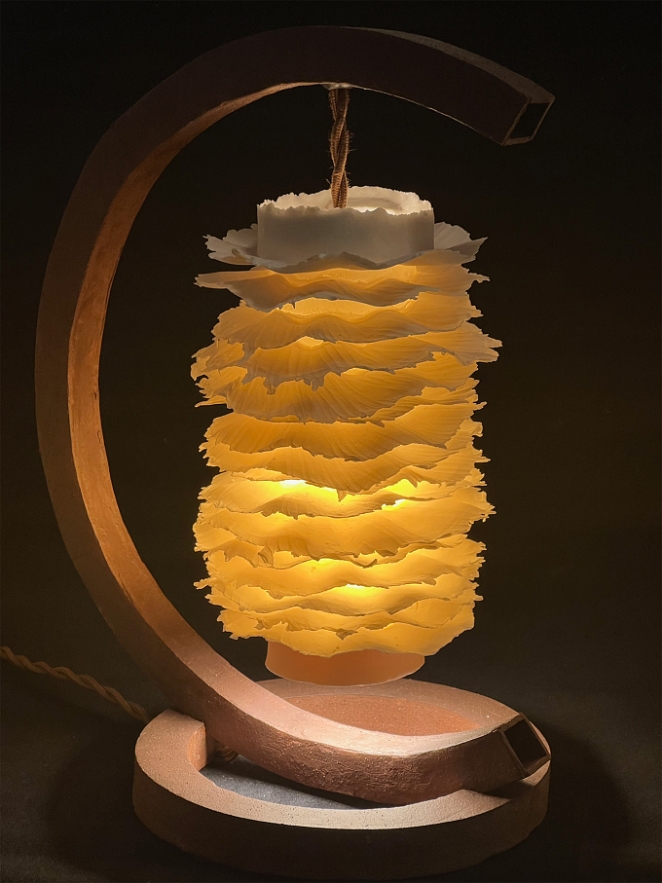
I also think that work that’s inspired by natural forms is here to stay and can complement both minimalist and maximalist settings.
What do you think sets apart truly exceptional creatives from the rest of the pack?
Willingness to take risks and follow their passion rather than follow trends.
What is the one thing that you would change about the industry?
More support for new entrants.
Any websites, books or resources you would recommend?
For anyone who’s serious about producing in clay, Florian Gadsby’s book ‘By My Hands’ is a good read.