
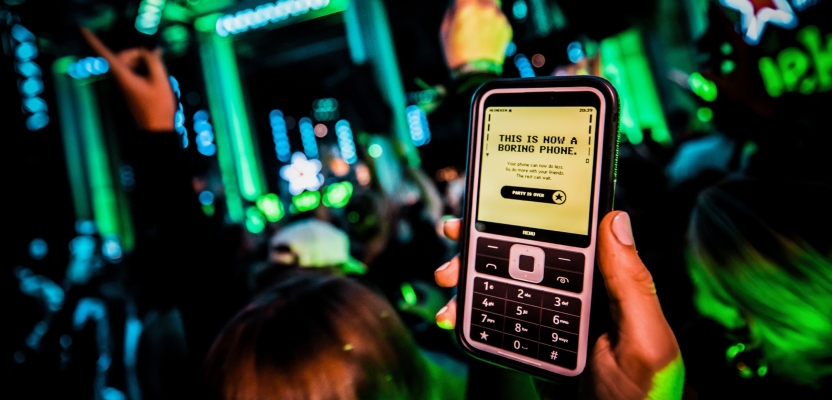

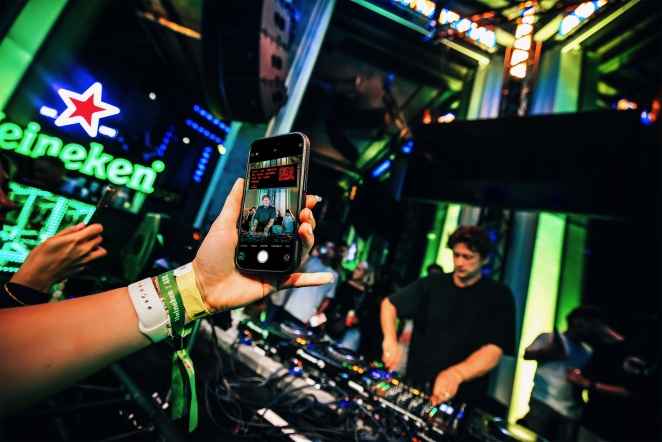
In an era where smartphones often steal the spotlight at live events, Heineken has taken a bold step to reclaim the magic of live music with its innovative "Boring Phone" campaign. Through a clever use of infrared technology, this groundbreaking initiative delivers hidden messages visible only through phone cameras, encouraging concertgoers to put their devices down and fully immerse themselves in the moment.
From conceptual sparks to the high-stakes production process, the campaign is a testament to creative ingenuity and Heineken’s commitment to fostering authentic social connections. In this exclusive interview, we delve into the vision, challenges, and remarkable collaboration behind this captivating activation.
Interviewee names and job titles
Sol Ghafoor - Chief Strategy Officer at Le Pub
Andrey Tyukavkin - Head of Creative Innovation, LeGarage
Mauro Mazzei - Global Head of Creative Technology, LeGarage
Vittorio Cafiero - Head of Innovation and Digital Production, LeGarage
What was the brief? Sol Ghafoor - Chief Strategy Officer
For 150 years, Heineken has been about more than just beer – it's about creating good times. As Freddy Heineken once said, "I don't sell beer, I sell good times."
But today, distractions are stealing those moments, and we're on a mission to bring them back. Enter the Boring Phone campaign: with a device designed without many features that distract us from the moment.
The brief was to extend this campaign platform and mission to live music. Concerts today are dominated by smartphones, with people recording memories rather than living them—something even artists and DJs are calling out. Our research showed that 41% of Gen Zers and Millennials feel frustrated seeing a crowd of phones at concerts, and 35% admit they check their phones more than they should when socializing.
So, we wanted a new and inventive way to get our message across so people wouldn't miss out on good times at concerts.
How did the initial pitch/brainstorming phase go? Sol Ghafoor - Chief Strategy Officer
It began with understanding how people engage with their phones at live music events. Often, the most powerful moments end up being recorded on screens instead of being experienced firsthand—we’ve all seen the sea of phones lighting up the crowd.
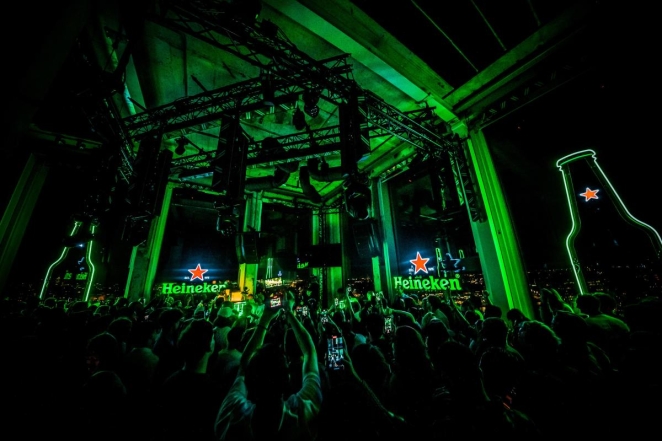
This inspired us to find a way to disrupt that pattern. While typical approaches, like QR codes on billboards, only keep people tethered to their screens, we wanted to encourage them to put their phones away, even if just for a moment. So, we had to think differently
What was the process behind ideating the concept? Sol Ghafoor - Chief Strategy Officer
We realized the most disruptive way to deliver our message was directly on the phones themselves, aimed precisely at those recording through their cameras. This led us to a question: What can only be seen through a phone?
Through research we discovered that infrared light, invisible to the naked eye but visible through a camera lens. With this fact, our idea took shape: what if we could deliver a hidden message, visible only to those watching through their screens, nudging them to put down their phones and fully soak in the experience?
What was the production process like? Vittorio Cafiero - Head of Innovation and Digital Production, LeGarage
The process was highly iterative. We knew that infrared light could be picked up by most cameras, and by almost every smartphone. From there we started experimenting with regular lights, reflective IR films, IR absorbing paints.
The first results were not promising, therefore we changed our approach and embraced direct lighting, similarly to led-walls technology where users are exposed to the source of light, in this case LEDs. LEDs do not emit IR light, though, so we had to find diodes that did. The “illuminating” solution came from the security world, where IR illuminators are used to shed light in dark areas for CCTV.
By combining IR illuminators as a direct source of light and large acrylic masks on the front of them, we were able to shape the messages that fans at Live Out and ADE’s opening party enjoyed.
What was the biggest challenge during production? How did you overcome it? Vittorio Cafiero - Head of Innovation and Digital Production, LeGarage
Sourcing the correct electronics in the quantity needed for our two installations, one in Mexico and one in The Netherlands, and within our timeframe, was by far the greatest challenge. Even though IR illuminators are consumer products available on platforms such as Amazon, their scarcity posed a threat to the actual delivery of the project.
In Mexico, for example, we received the electronic supplies 15 hours before the festival gates opened, leading crews to work non-stop all night for assembling and fine-tuning the installation.
What kit/tools/software were used to create the project? Vittorio Cafiero - Head of Innovation and Digital Production, LeGarage
The structures we created were totally custom, and were different in size, with the Mexico one being twice as big as Amsterdam’s. While the former was sitting on the stage, the latter was hanging above the DJ booth, so we had to take into account weight reduction, and opted for laser cut aluminium frames, a custom energy distribution system that focused on optimizing heat dissipation.
What is one funny or notable thing that happened during production? Vittorio Cafiero - Head of Innovation and Digital Production, LeGarage
With electronic supplies being delivered late in the evening, the crew in Mexico worked relentlessly all night and finished the fine-tuning at 6:58AM, just two minutes before choreographers and sound technicians began the sound check.
What’s the main message of this project and why does it matter? Andrey Tyukavkin - Head of Creative Innovation, LeGarage
Concerts are for people, not for the phones. After all, you arrive at a show with one goal: to enjoy the incredible energy created between the artist and the crowd. It is a highly social setting, and the phones are clearly becoming an obstacle.
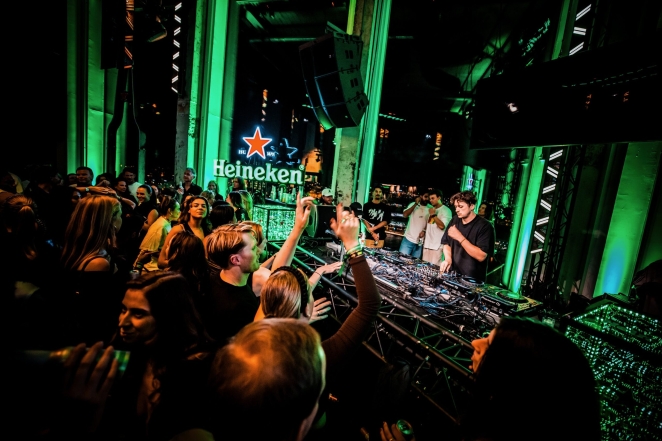
We simply reminded music fans that only humans can generate and sustain this passion — and phones instead can take a little rest, switching them into a boring mode that won’t distract you from the show.
How long did it take from inception to delivery? Andrey Tyukavkin - Head of Creative Innovation, LeGarage
The Boring Phone / Boring mode platform is being developed since January 2023, launched in April 2024, and is still an ongoing activity on many markets. This “Infrared hijack” was one of the ideas conceived around end of summer 2024 as an amplification tool, and the hardware part was implemented over just 3 weeks prior to launch. It was very intense.
Can you describe the creative spark or inspiration behind the initial concept? Was there a specific moment or insight that ignited the idea? Andrey Tyukavkin - Head of Creative Innovation, LeGarage
The idea “Concerts are for people, not phones” required us to find something that, in contrary, is seen only by phones and invisible to the naked eye. Infrared tech, a “boring” technology from the last century, and so common to be found in everyone’s TV remotes at home, solved that and made the idea even more aligned to the already existing world of The Boring Phone.
How did you ensure that the concept aligned with the brand's values, goals, and target audience? Sol Ghafoor - Chief Strategy Officer
Heineken champions social life, and in today’s world, digital distractions—especially from smartphones—are some of the biggest barriers to enjoying good times in IRL. Live music, one of our core pillars, is the perfect stage for us to inspire real connection and good times. We want our audience to live in the moment, not just record it.
Were there any alternative concepts or ideas considered during the ideation phase? If so, what led to the selection of the final concept? Andrey Tyukavkin - Head of Creative Innovation, LeGarage
The activation was paired with many other acts around The Boring Mode and The Boring Phone, amongst which offline treasure hunts to have people “find” their Boring Phone, lockers in festivals where people could lock their smartphone and get a Boring Phone in exchange, camera stickers to discourage people from filming whole gigs, and a broader set of assets made to bring light to the issue of phones being too distracting for social life. But the good ones we’re not telling you because we’re gonna get them out soon :)
Can you discuss any collaborative or interdisciplinary aspects of the ideation process, such as working with other departments or external partners? Andrey Tyukavkin - Head of Creative Innovation, LeGarage
This innovative concept was brought to life through a collaboration between Le Garage (Le Pub's innovation hub) and two key partners: Roma 212 Creative House from Mexico and Zero from Milan, Italy, for Amsterdam’s installation. It required great collaboration between the agency and Heineken. It was a globally driven initiative that found its way to most relevant markets and artists.
What role did consumer research or market analysis play in shaping the concept and its execution? Sol Ghafoor - Chief Strategy Officer
Our dedicated team, the Data & Culture Lab, dives deep to unearth unique insights for every brand we support. Each brief is driven by consumer and cultural data to ensure our strategies and ideas resonate with our audience. For this campaign, we conducted in-depth research across key markets and engaged in ethnographic studies to understand how people truly behave.
Can you discuss any unique or unconventional production techniques or approaches used to bring the idea to life? Mauro Mazzei - Global Head of Creative Technology, LeGarage
In our way of working, the internal tech and R&D departments are involved from the idea-creation stage. This allows us to develop early-stage prototypes from the very first presentation. It’s a cross-department collaborative approach that speeds up the validation process and feasibility checks.
With a solid understanding of the technology and possible execution, working with external partners becomes much easier. We’re able to share initial concepts, code, or knowledge as a starting point to avoid pitfalls and accelerate production.
How did you ensure that the concept remained innovative and stood out in a crowded marketplace? Andrey Tyukavkin - Head of Creative Innovation, LeGarage AND Mauro Mazzei - Global Head of Creative Technology, LeGarage
The innovative nature of this projects stems from the simplicity of the tech used. Many of us have been in briefs where it was desired to make a message “appear” on smartphones, but up until now we’ve been dependent on QR codes and web apps to let that happen.
The implementation of infrared tech to “hide” messages for phones in crowded spaces is a step forward for the whole industry, while simultaneously being perfectly on strategy for Heineken, as yet another way in which “boring” tech can help improve social life.
What do you hope it achieves for the brand? Sol Ghafoor - Chief Strategy Officer
We want our audience to see the brand as a true enabler and champion of social life, by bringing people together and enhancing their shared music experiences in a unique and inventive way, over a Heineken of course.
Credit list for the work?
HEINEKEN Global
Sr. Director Global Heineken® Brand: Nabil Nasser
Heineken® Global Communication Director: Daniela Iebba
Heineken® Global Digital Director: Rob van Griensven
Heineken® Global Communication Manager: Guilherme de Marchi Retz
Heineken® Global Head Digital Consumer Innovation: Natacha Volpini
Heineken® Global PR Lead: Jonathan O’Lone
Heineken® Global Brand PR Manager: Joseph Brophy
Heineken® Global Business Specialist: Colleen Muller
LE PUB
Global CEO LePub, CCO Publicis Worldwide: Bruno Bertelli
Global Chief Creative Officer: Cristiana Boccassini
Chief Creative Officer: Mihnea Gheorghiu
Executive Creative Director: Andrey Tyukavkin
Executive Creative Director: Eoin Sherry
Executive Creative Director: Felipe Ferreira
Executive Creative Director: Gaston Soto
Creative Director:Corina Patraucean
Creative Director: Rainor Marinho
Creative Director: Marie Poumeyrol
Head of Art: Andrea Ferlauto
Associate Creative Director: Valentino Borghesi
Associate Creative Director: Geo Joseph
Art Director: Christopher Jones
Art Director: Flavia Conti
Copywriter: Cristiana Candido
Junior Art Director: Peter Sjo
Global Head of PR & Communication: Isabella Cecconi
Senior PR Manager: Eleonora Botta
Global Head of Creative Technology: Mauro Mazzei
Head of Digital Production: Vittorio Cafiero
Digital Producer & Project Manager: Kejsi Haxhi
Chief Strategy Officer: Sol Ghafoor
Global Client Service Director: Shirine Aoun
Global Client Service Director: Ilaria Castiglioni
Account Director: Rossana de Rosa
Account Director: Gonzalo Gutierrez
Account Executive: Candida Franchi
Account Junior: Clara Boggia
Chief Production Officer: Francesca Zazzera
Head of TV Production: Anna Sica
Post-Producer: Margherita Fonseca
Editor: Claudio Roveda
Videomaker: Tommaso Bianchi
Production House Amsterdam: Bandit Productions
Producer: Lio Dijkman
LE PUB MX
Chief Creative Officer: Aldo Rámirez
Chief Creative Officer: Ricardo Aviles
Creative Director: Marco Garcia
Creative Director: Juan Pablo Balcazar
Art director: Nestor Franco
Senior Copywriter: Pedro Pablo Bergelund
Managing Director: Almudena Blanco
Account director: Nataly Gañan
Senior Account Supervisor: Daniela Peridgón
Production Director: Roberto Collazo
Production Manager: Lizeth Torres
Productor: Ana Galván
Productor: Lizeth Pérez
THE ROMANS
Director: Kate Brazier
Senior Account Directors: Sophie Lambert-Russell, Andy Ruscoe