

For Julia Bohdan-Piatrova, design has never been just about visuals — it is about meaning, responsibility, and communication. Now based in Poland and working as a freelance designer, Julia’s path into the creative industry was shaped by profound personal and political upheaval. From building a product from the ground up — logo, packaging, website, and Amazon launch — to discovering her passion for infographics, her work sits at the intersection of product design, storytelling, and emotional clarity.
Against the backdrop of displacement from Belarus, the war in Ukraine, and a rapidly changing creative landscape, Julia has used design not only as a profession, but as a way to help others. From creating the multilingual Aceisida font to supporting creatives affected by conflict, her approach is deeply values-led. In this interview, Julia reflects on her creative process, the role of technology and AI, the future of design, and why infographics should be treated as a conversation — not just a sequence of slides.
How did you first get into the industry?
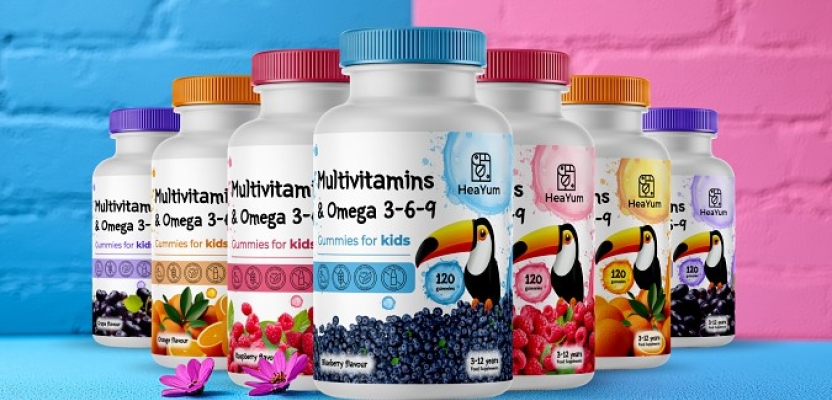
 I had a chance to pour all my creative potential into one project that required pretty much everything. I even felt like a business partner at times, helping to build everything from the ground up — starting with the logo, designing multiple packaging options, picking fonts and a color palette, designing the website, and finally creating the creatives and launching the product successfully on Amazon.
It was an opportunity to try myself in many areas of design and really feel out what I was most drawn to. And if life gives me opportunities — I take them. That’s actually how I realized my vision for the final product goes way beyond the logo and packaging. I wanted to tell its full story to the end consumer, to ensure that every step was in harmony — that’s how I came to infographics.
Or rather, something at the intersection of product design and infographics, with a focus on infographics.
Where are you based now and who do you work for?
I live in Poland and work as a freelancer.
What is your personal background and what role did it play in your career?
 My journey in design started after the events in Belarus in August 2020 — COVID, brutal crackdowns on peaceful protests, growing repression. My family had to leave, and we ended up in Poland.
I immersed myself in design — I took courses in UI/UX, graphic design, composition, web design, and a bit of motion design. I was searching — what can I do, what can I offer — to others and to myself, and how can I turn that into a meaningful path.
Another pivotal moment was the war in Ukraine. I was deeply worried for my family there, and it was heartbreaking to realize that after everything happening inside Belarus, our country, by the dictator’s will, ended up being dragged into a monstrous war. The territory was used by Russian soldiers not to intensify repression inside, as many Belarusians thought, but for something even worse — an attack on Ukraine.
At that point, I started thinking — what more can I do for Ukrainians, besides financial support? How can I help through design? And the answer was — the font. Fonts are used everywhere, which meant I could support Ukrainians who had to change careers and go remote — including into design — by giving them something they could use for their portfolios or projects.
That’s how the multilingual font Aceisida was born. It’s free for both personal and commercial use in Ukrainian.
Over time, working as a freelancer and continuing to study, I arrived at infographics — it turned out to be the format where I could merge different facets of design and tell the full story of a product.
If you weren’t in your current industry, what would you be doing?
One way or another, I would still be connected to creativity—maybe handmade work, business and idea generation, creating a product or service that helps people in life. Maybe I’d write a book.
Can you explain your creative process? What makes it unique?
 One of the questions I often ask clients is — what feeling do you want your product to evoke? What emotion do you want to pass on to your customers?
Because my job as a designer is to catch that feeling and express it so it clearly communicates the client’s original message.
But this approach also sets certain boundaries, because sometimes it’s difficult—or even impossible—for me to design for certain products if I doubt their potential usefulness, or after researching them, I couldn’t find convincing enough reasons why they would benefit other people. For me, design must have meaning.
How would you describe your style?
I love experimenting with styles. But what resonates with me the most is vintage — even closer to Edwardian style — minimalism, something a bit cinematic (action), and bright, sometimes playful or childlike. I love mixing styles — I feel that by experimenting you can arrive at something truly extraordinary.
Which individuals do you gain inspiration from? Do you have any heroes in the industry?
I try to look openly at everything around me.
Interior designers are amazing at combining colors and textures. Music helps me tune in — for example, composers and studios like Cheiron, Desmond Child — they’re great at creating harmony, placing accents, and experimenting with genres.
It’s a different form of art, but artists of all kinds can inspire one another.
In design, I also love browsing through illustrators’ work — some of them come up with absolutely fantastic concepts.
What kind of tools/kit/software could you not do without?
Figma, Illustrator, Perplexity, DeepSeek, ChatGPT, Midjourney, Adobe Firefly.
What’s the work achievement you’re most proud of?
 The Aceisida font and the first major project I mentioned earlier—taking it from zero to a real-life launch.
As someone with experience in the industry, what trends do you foresee shaping the future of creativity?
I think the demand for high-quality work will keep growing. With the advancement of tech, clients are becoming more selective — “just good” won’t be as eager to accept. The bar is rising.
There’ll be more focus on individual work rather than mass production — because “just like everyone else” will be easy to do.
I might be wrong, but I feel that the change of generations shift is also leaving its mark on how business — and therefore design — is evolving. Less showboating, fewer exaggerated promises, and more and more truth backed by actual proof — on packaging, in marketing, in listings. Brands are focusing more on quality, materials, and ingredients.
How do you think technology has influenced the creative industries and how have you adapted to these changes?
I feel like AI has blurred the lines between many disciplines. It’s become so much easier to bring a sudden idea to life — and that’s incredibly exciting.
From concept development to target audience research, content planning, and even business strategy — one of the key skills now is being able to ask the right questions.
Before, bringing an idea to life could take forever, and required a whole team. Now, when inspiration strikes and you’re in that “flow” state — you can accomplish a lot.
As for adapting — I’d say I’m in the process. There’s just so much new information, and it evolves so quickly. You have to absorb it in manageable doses, choose what accelerates your current work, and keep moving forward.
What is the one thing that you would change about the industry?
 I wish infographics were seen not slide by slide, but as direct speech—as a conversation with the customer. Like a presentation, where everything is coherent, clear, and convincingly demonstrated. To convey values, show the product’s advantages—so it all becomes one cohesive story. I think it may be time-consuming, but it’s very engaging and draws people in. And the more attention given to it, the more likely the product will be bought.
By the way, that’s exactly what my latest project was about—the one I submitted to the Creativpool Awards.
Any websites, books or resources you would recommend?
If the format allows, I’d like to use this opportunity to ask support for the BYSOL Foundation and the Belarusian Solidarity Center in Poland.
They provide legal and humanitarian aid to Belarusians who face repression.
Since the war in Ukraine began, the topic of human rights in Belarus has taken a back seat — understandably — but unfortunately, the problems haven’t gone away.
So I’d like to draw attention to these organizations and ask for support them.