Chris Newberry
Middleweight Industrial Designer
ABOUT
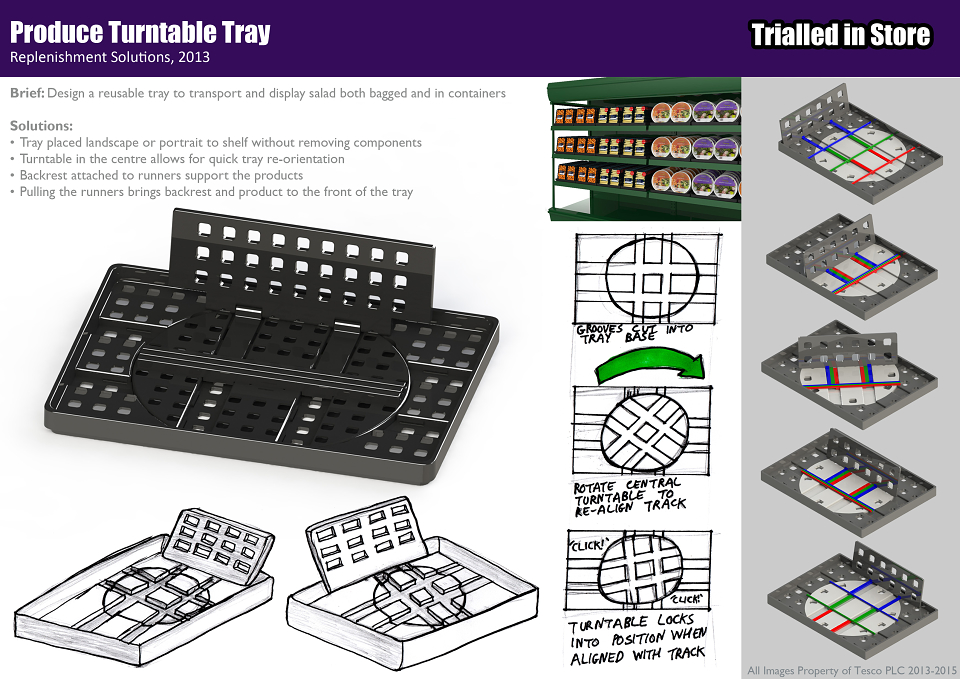
Project Brief: Design a reusable tray to transport and display salads both bagged and in containers
Current Process Issues
• Current transportation of bagged or contained salad is loose in large green trays, where a lot of dead space is being transported in delivery vehicles. For example, the green tray could only hold four large salad bowls.
• When in store, the product is placed on the shelf one-by-one which is time-consuming.
• Over time when product is bought, the shelves look depleted and untidy, meaning shop floor colleagues have to bring the items to the front of the shelf and tidy the area frequently; also time-consuming.
Design Solutions
• The dimensions of the tray ensured that at least 80% of the product lines in scope could be held in the tray and maximise the product capacity, meaning less dead space transportation. Continuing from the example earlier, the new tray could now hold six large salad bowls.
• The tray and its products could be placed on the shelf in one go, thereby speeding up the replenishment time.
• The design of this tray included a backrest, allowing for products to be stood up with the label facing the front
• The backrest was attached to runners which staff could pull towards the front of the tray bringing the backrest and the product forward quickly, saving more time.
• Backrest can be inserted either landscape or portrait to the tray to allow for maximum shelf capacity.
Key Innovative Feature
At the time when I joined this project, the backrest and runners was a loose tray insert, which raised concerns that this component would get lost in transit of thrown away by staff after use. It was then asked that I find a solution that helped secure the backrest to the tray without losing its ability to be repositioned either landscape or portrait.
To solve this problem, I came up with placing a circular disc in the centre of the tray with channels cut into it and the tray. The runners and backrest fit securely into the channels and all the components can be brought into the centre of the disc and rotated 90 degrees to align with the channels on the tray, either landscape or portrait, without removing any components.
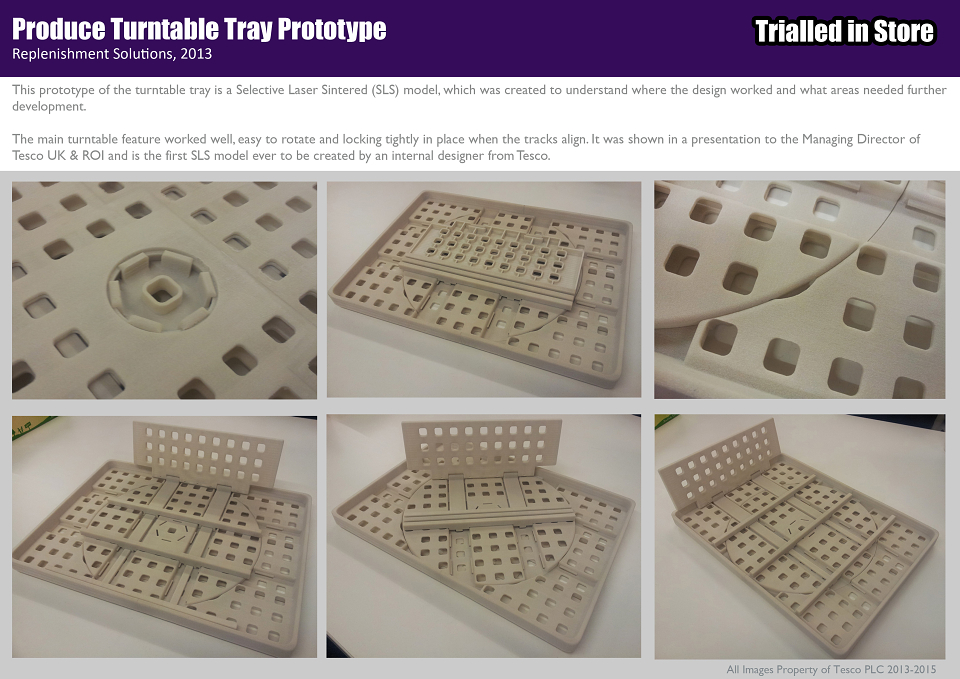
A Selective Laser Sintered (SLS) prototype of the turntable tray was made to help understand where the design worked and what areas needed further development. The main turntable feature worked well, easy to rotate and locking tightly in place when the tracks align.
Why I Chose This Project
The tray did resolve a lot of the issues set out from the brief, improving both transportation and store productivity; it received good feedback from store and distribution colleagues when in trial.
This project was recognised by the business as good design work and helped me to get noticed as a product designer in the company. The prototype was shown in a presentation to the Managing Director of Tesco UK & ROI and is the first SLS model ever to be created by an internal designer from Tesco.
This project demonstrates my ability to solve problems through innovation and my ability to develop a piece of functioning equipment that fulfils the requirements of the brief.