

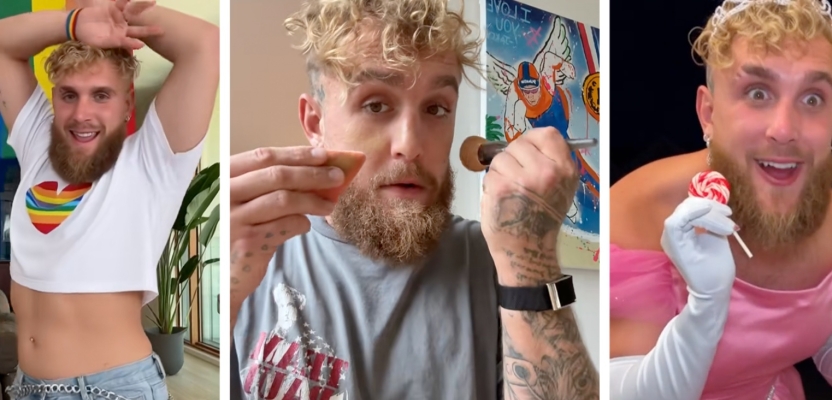

When AI first crashed into the creator economy, the promise was simple: faster, cheaper, easier content. But as Jake Paul’s eerily lifelike AI clones flood social feeds and brands scramble to ride the Sora 2 wave, one truth is becoming impossible to ignore: convenience isn’t the same as creativity.
Billion Dollar Boy’s Chief Innovation Officer and Co-Founder Thomas Walters explores how brands and creators can move beyond the hype. Drawing on fresh global research into how audiences, marketers and creators are responding to the rise of AI-generated content, Walters makes a powerful case for a new kind of innovation where craft, originality and human storytelling reclaim centre stage.

By now, most of us have seen the AI-generated clips of Jake Paul doing makeup tutorials and outfit hauls. They’re everywhere - not because Jake’s pivoting to beauty, but because he opted in to a Cameo request via OpenAI’s new Sora 2 feature, allowing creators to license their likeness for AI-generated appearances. He’s become everyone’s guinea pig.
And that’s the thing: Sora 2, alongside tools like Meta Vibes, is making it almost absurdly easy to produce slick, hyperrealistic AI video content. It’s opening the floodgates of creative potential. We’re seeing brands like Mattel use it to visualise products faster, prototype ideas, and accelerate storytelling at a scale we couldn’t have imagined a year ago.
That’s the good news.
The not-so-good news? It’s also making it easier to churn out what many are now calling AI “slop” - low-quality, mass-produced content - which is flooding feeds and testing the limits of consumer trust.

A prime example of AI slop
At Billion Dollar Boy, our latest global research shows that AI in creator marketing is at a tipping point: spend is surging, creators are embracing it, but audiences are growing more sceptical. The lesson for brand leaders? Speed and scale aren’t enough anymore. The next stage of AI success will belong to those who wield it with purpose.
AI Ad Spend Soars and So Does Creator Adoption
We surveyed 6,000 consumers, creators and marketers across the US and UK. The numbers reveal the industry’s intent: four in five marketers (79%) increased investment in AI-powered creator content this year, and three-quarters plan to divert even more spend from traditional creator collaborations over the next 12 months.
The logic is clear. AI delivers efficiency and performance. Eighty-one percent of marketers say it’s made creator partnerships more cost-effective. Seventy-three percent report that AI-integrated content performs better than human-only output.
AI isn’t replacing the creator economy; it’s redefining its growth trajectory
And creators are seeing the upside, too: 87% have increased their use of generative AI this year, and 85% say it’s boosting their earning potential.

This shift is driving a broader budget reallocation across the advertising industry - particularly in the US, where 71% of marketers now spend over $1 million annually on creator marketing. AI isn’t replacing the creator economy; it’s redefining its growth trajectory.
Consumer Sentiment Is Splintering
The challenge lies on the other side of the equation: the audience.
In 2023, 60% of consumers told us they preferred AI-generated creator content. This year, that number has plummeted to just 26%. Meanwhile, the share of consumers who view AI as a negative disruptor to the creator economy has almost doubled.
The novelty has worn off and fatigue is setting in
Why the backlash? It’s not AI itself, it’s how it’s being used.
Consumers are still excited by AI that enhances originality and diversity: 38% say it’s improving quality, and 41% agree it’s broadening representation. But they’re tuning out of the endless stream of copycat AI clips clogging their feeds. The novelty has worn off, and fatigue is setting in.
The Opportunity: Craft, Not Chaos
So where do we go from here?

AI is clearly here to stay. Platforms like Sora 2 and Meta Vibes will continue lowering the barrier to creation, inviting millions more people to experiment. But history tells us only a small fraction of online communities actually create content that stands out: 4% of YouTube videos account for 94% of views on the platform; 5% of videos on TikTok generate 89% of the views; 3% of Instagram videos earned 84% of all views.
5% of videos on TikTok generate 89% of the views
That’s the opportunity.
In a landscape flooded with noise, craft becomes the differentiator. Brands and creators who apply AI to amplify creativity, not automate it, will win both performance and trust. The creators and brands applying AI strategically are seeing real performance gains. But mass-produced, unlabelled and poorly conceived content is fuelling negative sentiment. Consumers aren’t rejecting AI - they’re rejecting mediocrity.”
Three lessons for marketing leaders from our research:
-
Utility first. AI must deliver genuine value - whether that’s entertainment, efficiency, or education. If it’s not making something better or faster for your audience or creators, it’s just clutter.
-
Quality over quantity. Resist the temptation to use AI purely to fill feeds. Every output should serve a strategic purpose or deepen audience engagement.
-
Protect what’s unique. As likeness licensing and AI-generated personas become mainstream, IP protection will be critical. If anyone can generate you, how do you preserve what makes you distinctive?
Beyond the Hype
We’ve officially entered AI’s “post-honeymoon” phase. The initial excitement has given way to critical evaluation - and that’s healthy. It’s how every technology matures.
Audiences don’t want more content they want better stories
Our upcoming report, Muse Two: The Real Impact of AI on the Creator Economy, digs deeper into this evolution: from vibe marketing and synthetic influencers to ethical blind spots and trust metrics. What’s clear already is this - spend alone won’t guarantee success in the next chapter of AI-powered creator marketing.

The winners will be the ones who balance machine capability with human creativity. Who use AI not as a shortcut, but as a springboard for imagination.
Because in the end, audiences don’t want more content. They want better stories.
Alma André Castilho October 29th, 2025, late at night
As a storyteller working closely with AI, I really resonate with this shift from efficiency to imagination. The first wave of GenAI helped us do more. Now we have the chance to feel more.What truly matters isn’t how fast we can produce, but how deeply we can connect. Technology can automate craft, but it can’t automate meaning. That still comes from lived experience, emotion, curiosity, and risk — the invisible ingredients that make a story worth remembering.
If we embrace AI not as a shortcut, but as an amplifier of human creativity, we unlock a more interesting future: one where imagination becomes the real competitive edge. Convenience may scale content. Creativity scales impact.
I’m excited for this next era — where machines accelerate us, but humans still lead the way.