

Where do you see yourself in five years? That’s a pretty bog-standard question most of us will have been asked at some point in an interview or on a first date. It’s a “getting to know you” cliché. It’s also a question that’s becoming harder and harder to answer, particularly for creatives who can not only feel, but see the ground shifting beneath our feet. For some of us, it can feel as if it’s falling away entirely.
Technological advancements, evolving consumer behaviours, and profoundly new work paradigms are rewriting the rules daily. So, as we look toward the next five years, fundamental shifts are emerging that promise to redefine how creative work happens – from the spark of an idea to its development and ultimate delivery.
The very meaning of “creative work” is poised for evolution. As Michelle Rigot, Group Creative Director at YAMA Group, puts it: “The next five years won’t just reshape how we create – they’ll redefine what creative work means.”
Immersive XR: Expanding the Creative Canvas
Igor Pavlovic Pointet
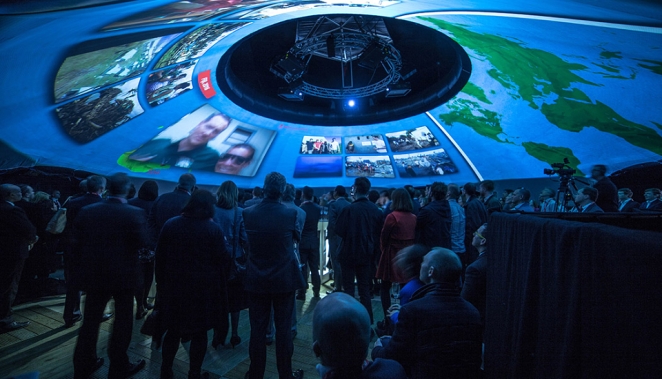
Immersive technologies like extended reality (XR) (an umbrella term covering virtual, augmented, and mixed reality) are opening a new dimension for creativity. XR blends the digital and physical worlds, allowing humans to transcend spatial boundaries and unlock experiences previously unimaginable. In practical terms, this means that creative work is no longer confined to flat pages or screens; instead, ideas can be brought to life as interactive, 3D experiences that fully engage an audience’s senses.
Already, augmented and virtual reality are growing as creative tools, offering novel ways for creatives to engage consumers and craft immersive stories. For example, design and advertising teams can use VR to prototype entire environments or virtual storefronts, while AR lets brands overlay digital art onto real-world settings. Industry experts note that XR is “driving a shift toward more immersive and interactive projects, setting new standards for what visual media can achieve” across fields from fine art to commercial marketing.
Entertainment and events are being reimagined through virtual concerts and interactive exhibitions that reach global audiences beyond the limits of physical venues. In education and training, XR simulations enable hands-on learning in lifelike scenarios – a development that hints at how tomorrow’s creatives might learn and hone their craft in virtual studios or classrooms.
Crucially, immersive tech is not just changing how creative content is experienced by audiences, but also how it is developed and pitched. Creative teams can meet as avatars in shared VR spaces to brainstorm and prototype in 3D, simulating physical presence despite being continents apart.
Agencies are already leveraging this: Rigot notes that at YAMA Group, “distance merely sharpens the value we place in being together,” which inspired their YAMA Live program of immersive creative engagements. By bringing teams and clients together in person or in virtual environments, they create visceral storytelling experiences that linger long after everyone heads home. In essence, XR is expanding the creative canvas – enabling creatives to build worlds and narratives that audiences can step inside of, forging emotional connections in ways traditional media simply can’t.
Decentralised Collaboration: Creativity Beyond Borders
Mazen Elgamal
Another profound shift in the coming five years is the rise of decentralised collaboration – the ability for creative talent to co-create without sharing the same physical space (and even without the same employer or time zone). What began as a pandemic-driven surge in remote work has evolved into a new normal for the creative sector. Today, it’s common for a project’s copywriter in London to work with a designer in São Paulo and a strategist in Singapore, all connected by digital collaboration tools.
This borderless workflow is redefining how ideas are born and developed: by democratising who gets to contribute. Companies now tap into a globally inclusive talent pool, accessing a wider array of perspectives and innovations than ever before. When you bring together diverse creatives from different cultures and disciplines, creativity often flourishes – fresh ideas emerge that might never surface in a single-location team.
Michelle Rigot attests that for her agency, “decentralised collaboration isn’t a trend… it’s how we operate.” YAMA Group’s team works across continents and time zones, proving that creativity not only spans borders – decentralised collaboration actively enhances it. From their different vantage points, team members challenge each other’s assumptions and build richer, more resonant work. Research backs this up: connecting people through broader virtual networks can “increase the collective speed and creativity of innovation efforts” by widening the pool of minds that share ideas.
In fact, recent experience has shown that a lack of physical proximity need not hold back innovation – it can fuel it when managed well. Global creative teams often leverage “follow-the-sun” workflows, using time zone differences to their advantage for faster iteration and continuous productivity.
Of course, making decentralised creativity successful requires intention. Leading studios are investing in collaboration platforms, virtual whiteboards, and cloud-based design suites to enable real-time co-creation. They’re also finding that periodic face-to-face touchpoints – whether via video hangouts or occasional in-person offsites – help maintain a unified vision and company culture. Rigot observes that while her team embraces working apart, “when we can, we align in person… distance only sharpens our appreciation for being together.”
In many ways, the creative workplace of 2030 may be a hybrid constellation: distributed by default but coming together (physically or virtually) for key moments of alignment, inspiration and human connection. By breaking the old notion that creative collaboration requires a single studio or city, the next five years will see creativity truly beyond borders – and likely, more vibrant and innovative because of it.
AI Co-Creation: Augmenting Imagination, Not Replacing It
Scott Balmer
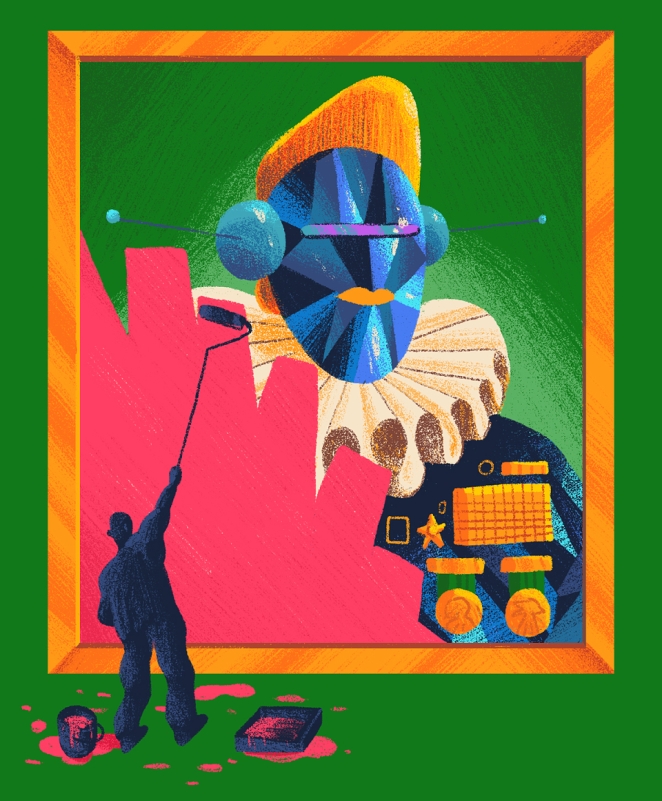
Perhaps the most buzzworthy catalyst for redefining creative work is the ascent of AI co-creation assistants. Generative AI has advanced from an intriguing experiment to a ubiquitous presence in creative workflows. Today’s AI tools can instantly generate copy, design drafts, code, layouts, even videos – tasks that used to take teams of humans days or weeks. This has raised an existential question across the industry: Will artificial intelligence replace human creatives? In truth, the story emerging is not one of replacement, but of rebalancing roles.
One recent report noted that the GenAI revolution is “shaking up every part of cultural production – from the first spark of an idea to how creative work gets out into the world”. In other words, AI is touching everything from concept generation to content distribution. But rather than rendering creatives obsolete, evidence suggests it’s changing what creatives focus on – and freeing them to elevate the parts of the work that only humans can do.
In many organisations, AI has become a creative team’s tireless sidekick. AI assistants can handle the tedious and repetitive tasks – from initial mock-ups to endless copy variations – allowing human creators to spend more time on conceptual, strategic and emotional elements of projects.
“We don’t resist it; we integrate it,” says Rigot of AI’s role at YAMA. “Not as a threat, but as a tool – like a calculator in a math class. AI takes the busy work off our plates so we can focus on what only humans do best: tap into emotion, create meaning, and tell impactful stories no one else can.”
This approach aligns with a growing consensus in the industry. Studies have found that teams pairing human creativity with AI capabilities often outperform either alone. In fact, research from MIT Sloan showed that when tasks “require creativity and the generation of novel ideas, human–AI collaboration tends to deliver the best outcomes”. Rather than automating creativity, AI is emerging as a collaborator – a creative accelerant that can supercharge human imagination.
None of this is to downplay the challenges and questions that AI brings. There are valid concerns about intellectual property (who owns AI-generated art?), the erosion of entry-level creative skills, and the risk of algorithmic homogenisation of style.
Creative professionals also worry about maintaining authenticity – after all, as one commentator noted, “AI can mimic form, but it doesn’t understand emotion… It might say the right words, but perhaps not in the right way or order”. The true value of human creatives lies in intuition, cultural context, and the “spark” of inspiration drawn from lived experience – qualities a machine lacks. That is precisely why the next five years will likely highlight the irreplaceable role of humans in the creative process.
As Rigot eloquently states, in a world where AI can do more and more, “what sets creative apart is what [AI] can’t do – feel, imagine, connect.” The fundamental job description of creative work may shift: less pixel-pushing, more guiding the vision. Creative professionals will increasingly act as editors, curators and strategists, wielding AI-driven tools to execute and iterate, while they ensure the output has heart, soul, and resonance. In short, AI will become a powerful creative partner – one that expands human possibilities rather than constricting them.
A New Creative Era: Tech as Engine, Humanity as Driver

Simon Whittaker
From immersive XR playgrounds to borderless teams and AI assistants, the coming half-decade promises to reinvent how creative ideas are born, developed, and sold. We will see ideas born from unprecedented cross-pollination – a concept sparked by an AI-generated prompt or a multicultural remote brainstorm.
We’ll see ideas developed in simulation and collaboration spaces far removed from the traditional studio – whether that’s a designer fine-tuning a concept in augmented reality or a globally distributed team co-creating in the cloud. And we’ll see ideas sold through experiences and channels that make the audience a participant – be it an interactive VR brand experience or personalised content tailored by machine learning to each viewer.
Importantly, through all these shifts, human creativity is not becoming less relevant; it’s becoming more so. The tools and platforms may evolve, but the emotional core of great creative work remains the same. Technology might set the stage, but it’s there to serve creativity, not eclipse it.
As we look ahead five years, creative professionals should feel encouraged to embrace these changes with a spirit of curiosity and adaptability. The future of creative work is one where technology is our engine, but humanity is our driver – a future in which the most successful creative endeavours will marry cutting-edge tech with the timeless human touch.
By harnessing immersive mediums, embracing collaboration beyond borders, and co-creating with our AI “colleagues,” we can tell richer stories and solve creative challenges in ways previously unimagined. In redefining creative work, we are ultimately broadening creativity’s horizons – and that is an exciting canvas on which to paint the next chapter of our industry.
I’ll leave you with the words of regular Creativepool contributor and SomeOne Founding Partner Simon Manchipp: “In five years’ time, it’ll be less about making and more about mediating. You won’t draw the line—you’ll train the machine that does. Creative work becomes creative direction. Less execution, more taste. Style becomes strategy.”
So, let’s get stylish.