



Let’s start with the uncomfortable truth: a lot of creatives are not getting rejected because they’re untalented. They’re getting rejected because of one of the most common and avoidable creative job application mistakes; their applications are a complete mess.
Not always an obvious mess. Not “Comic Sans CV” mess. More often it’s a polished looking, quietly generic, accidentally self-sabotaging mess: the same cover letter sent to 40 roles, an overstuffed portfolio no one has time to decode, a CV full of vague claims, and just enough friction for a recruiter to think, nope, next.
These are the mistakes that keep good people stuck in the no-callback cycle.
And that’s what makes them so frustrating. The work might be good. The person might be good. But if the application doesn’t make that obvious quickly (and we mean quickly) it won’t survive the first pass.
Think of this as a practical intervention, not a scolding. The aim here is simple: identify the patterns that are killing otherwise strong applications, then fix them. Less “manifesting the right opportunity.” More “stop attaching 37 PDFs and calling it a strategy.”
Because in creative hiring, quality matters but so does clarity. And if your portfolio, CV, and cover letter don’t help someone understand why you’re relevant within seconds, the process will move on without you.
Why am I not getting interviews for jobs?
Dima Kashtalyan
Most rejections happen for reasons that have very little to do with talent. The problem is usually how the work is presented. Generic CVs, vague portfolios, inconsistent online presence, and untailored applications all create friction. Hiring teams are under pressure, and their process is designed to reduce risk quickly. If your application makes them work too hard to understand what you do, they’ll move on.
And yes, automation makes this worse. Many employers now use applicant tracking systems (ATS) to scan and sort CVs before a human even sees them. That means keyword relevance, formatting, and clarity matter more than many creatives realise. Portfolio review is also happening under time pressure, which is why quality, relevance, and easy navigation matter so much.
The other thing worth saying out loud: silence is common. Employers don’t always reply. They don’t always give feedback. That doesn’t automatically mean your work is bad. It usually means the process is crowded, inconsistent, and moving fast. The answer is not to panic-apply harder. It’s to apply smarter.
If you’re sending applications and hearing nothing back, it’s rarely because you “just aren’t good enough.” More often, one or more of these blockers is getting in the way.
1) Generic applications
This is the big one.
A lot of creatives use the same CV, cover letter, and portfolio for every role. It saves time, but it also tells recruiters you haven’t really applied for their job — you’ve applied for a job.
If your CV profile is the same for every application, it won’t feel specific enough to land. Recruiters are trying to match candidates to a brief. If your wording doesn’t reflect the role they’re hiring for, they’ll assume you’re not the right fit (or that you couldn’t be bothered to tailor it).
A much better approach is to keep a strong master CV, then adapt it for each role. Bring the most relevant skills and experience to the top. Cut what doesn’t matter. Use the language the employer is using. The same goes for cover letters: a short, tailored note beats a generic one every time.
2) The spray-and-pray approach
Sending your CV to every vaguely relevant role can feel productive. It usually isn’t.
The “spray-and-pray” method tends to produce silence because generic applications create generic outcomes. If you apply everywhere, you end up stretching your experience to fit roles that don’t really match and your materials lose focus.
A better strategy is to choose fewer roles and go deeper on each one. Read the brief properly. Look at the company’s work. Match your examples to what they actually need. Use the keywords and phrasing from the job ad naturally across your CV, cover letter, and portfolio descriptions so both people and systems can see the fit quickly.
Ten thoughtful applications will usually outperform a hundred rushed ones.
3) Not showing your best work first
If your CV or portfolio is long, cluttered, or unfocused, you may be getting filtered out before anyone reaches the good stuff.
Recruiters scan quickly. They don’t read everything in order. They look for immediate signs of relevance, credibility, and quality. If your strongest project is buried on page 14, it may as well not exist.
The fix is simple but painful: edit harder.
Keep your CV tight (two pages is a good rule of thumb for most roles). Highlight the achievements and experience that are most relevant to this job. For your portfolio, curate. Don’t include everything you’ve ever made. Include the work that best proves you can do the job you’re applying for.
This is not the moment for a “kitchen sink” portfolio. It’s the moment for a sharp one.
4) No proof or metrics
Vague statements don’t help recruiters make decisions.
Phrases like “worked on campaigns” or “helped with social content” are too soft on their own. They don’t show scale, impact, or ownership. You don’t need to turn your portfolio into a spreadsheet, but you do need to show evidence.
Instead of:
- Helped with social posts
Try:
- Created a social content series that increased engagement by 40% over three months
Instead of:
- Supported brand refresh
Try:
- Led visual rollout across web and social for a brand refresh delivered in a six-week window
Numbers help. Outcomes help. Clarity helps. The point is to make your contribution legible.
5) Spelling and grammar slip-ups
Yes, even for creatives. Especially for creatives.
Typos, grammar errors, broken sentences, and rushed formatting make your application feel careless. In a competitive hiring process, that can be enough to lose trust quickly.
This is one of the easiest mistakes to fix and one of the most frustrating to lose out on. Proofread everything. Then proofread again. Read it aloud. Get someone else to check it. Use AI tools to catch obvious mistakes if helpful, just don’t rely on them blindly.
If you’re a writer, strategist, designer, marketer, or anyone client-facing, attention to detail is part of the job. Your application should reflect that.
6) Missing portfolio link or inaccessible work
This is a surprisingly common (and often fatal) mistake.
If your portfolio link is missing, broken, hidden behind a password you forgot to include, or buried in a giant PDF attachment, many recruiters won’t chase you for it. They’ll move on to someone whose work is easier to review.
Make your portfolio easy to find and easy to open. A simple website link is ideal. If you’re sending a PDF, make sure it’s lightweight, clearly named, and actually viewable on different devices.
The golden rule: never make a recruiter work to access your work.
The real issue behind all of this
Recruiters scan for clues in seconds. If your materials look generic, overloaded, or confusing, they won’t get a second chance. The fix is to treat your application like a solution pitch, not a personal archive: tailored wording, relevant projects, clear evidence, and strong presentation.
How to stand out in job applications

Marija Sribna
Standing out does not mean being louder, weirder, or more “creative” for the sake of it. It means being clearer, sharper, and more relevant than the next person.
Here’s what actually works.
Tailor, tailor, tailor
Yes, it’s repetitive advice. It’s also correct.
Your CV and cover letter should show that you understand the role, the company, and what they need. Mention the company by name. Refer to the work if relevant. Mirror the language of the job ad where it makes sense.
If the role is for a “motion graphics specialist,” use that phrase if it genuinely describes what you do. Don’t hide behind vague titles like “creative ninja” or “visual storyteller” if the employer is searching for something specific.
Clarity beats cleverness in job applications.
Build a concise, relevant portfolio
A strong portfolio isn’t just a gallery. It’s a case for hiring you.
Show a small number of relevant projects and explain them properly. That means giving context:
- What was the brief?
- What was your role?
- What were the constraints?
- What did you make?
- What happened as a result?
Hiring managers are not just looking for nice visuals. They want to understand how you think, how you solve problems, and what kind of work you can deliver in real conditions.
Quality over quantity wins here every time.
Make your CV and portfolio feel like the same person
Your CV and portfolio should feel connected. If they look and sound wildly different, it creates doubt.
That doesn’t mean everything has to be heavily branded, but there should be a sense of consistency in tone, language, and presentation. If your CV says you’re a strategic, detail-focused designer and your portfolio is chaotic, vague, and hard to navigate, the message falls apart.
Your materials should reinforce each other, not contradict each other.
Use metrics and impact wherever possible
“Passionate,” “results-driven,” and “hard-working” won’t do much on their own. They’re filler unless backed up by evidence.
What gets attention is specificity:
- Increased conversion rate by X%
- Helped launch a campaign across Y markets
- Reduced production turnaround by Z days
- Grew audience engagement over a defined period
Even if you work in a more subjective discipline, you can still talk about outcomes: launches, approvals, stakeholder buy-in, deadlines met, testing results, retained clients, campaign reach, etc.
Proofread and polish everything
This one is boring, but it matters.
A typo in a headline. A broken link. Inconsistent spacing. Mismatched dates. These things quietly chip away at confidence.
Polish signals care. Care signals professionalism. Professionalism gets interviews.
Show personality, but keep it useful
Creativity is personal, and your application shouldn’t read like it was written by a compliance robot.
A bit of voice can absolutely help, especially in cover letters and portfolio copy. But personality should support relevance, not distract from it. Be memorable because you’re thoughtful and clear, not because you’re trying to perform “quirky creative energy.”
The test is simple: does this help someone understand why I’m a good fit?
Follow up professionally
If you get some interest, don’t disappear but don’t overdo it either.
A short, polite follow-up after a reasonable wait can help keep you on the radar. It shows professionalism and genuine interest. Just keep it concise, friendly, and respectful of their time.
And if you still hear nothing, move on without spiralling. The goal is momentum, not emotional attachment to every application.
How long recruiters look at applications
Neelam Shah
Not long.
This is why so many otherwise capable creatives struggle in hiring: they build applications as if they’ll be read carefully from start to finish. In reality, most are scanned first and only read properly if they clear that first hurdle.
Recruiters and hiring managers are often reviewing applications in batches, under time pressure, with multiple priorities competing for attention. So your CV and portfolio need to make sense at speed.
That means:
- Clear headings
- Strong first lines
- Easy-to-scan layout
- Bullet points where useful
- White space
- Immediate relevance
Dense paragraphs, long intros, and buried achievements make your application harder to process. And if it’s harder to process, it’s easier to reject.
The same applies to portfolios. Use clear project titles, define your role, and include outcomes upfront. Don’t assume someone will click through everything and decode your contribution. Make the key information obvious.
It’s also worth keeping your expectations realistic on timing. Hiring timelines are often vague, and delays are common. You might hear back in a week. You might hear back in three. You might never hear back at all. That uncertainty is frustrating, but normal.
The healthiest response is to keep refining your materials and keep your pipeline moving.
How to apply for a job on Creativepool
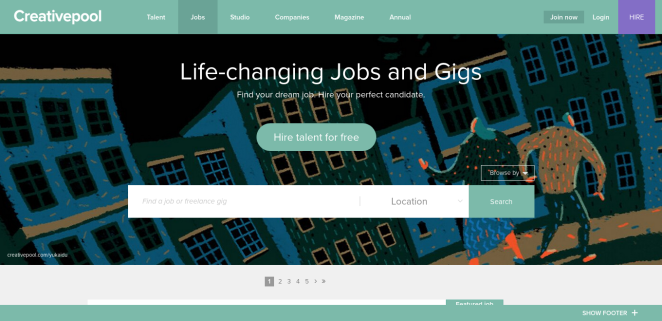
Applying well on Creativepool isn’t just about hitting the “Apply” button. It’s about making sure your profile, portfolio, and CV are easy to discover and easy to assess because employers use the platform for search and discovery as well as job listings.
Think of your Creativepool profile as more than a profile. It functions like a mini professional hub: CV, portfolio, and visibility layer all in one place.
Start with your setup, not the job post
Before applying, make sure your profile is doing its job.
1) Set the right job titles in Work Settings
You can choose up to three preferred job titles, and the order matters. Put the title you most want to be found for first. If you want to be hired as a Senior Designer but your top title is something broader or outdated, you may be making yourself harder to find.
Job alerts are also worth setting up properly (daily, weekly, or instant), especially if you want to apply earlier. Timing matters when strong roles attract a flood of applications.
2) Upload your CV and check who can access it
If your CV is uploaded but hidden too tightly, you may be reducing your chances without realising it. Review your privacy settings and decide what balance you want between visibility and control.
The important thing is to make a deliberate choice. Don’t assume your settings are helping you if you haven’t checked them.
3) Review your visibility settings
Profiles are typically public and searchable by default, but visibility settings can be changed, including whether you appear in search engines.
That’s useful if you need privacy, but it can also quietly damage discoverability. If you’re actively job hunting, make sure you haven’t accidentally made yourself invisible and then blamed the market for not finding you.
4) Make your projects searchable
Your job title, skills, tags, keywords, and project descriptions aren’t just admin fields. They help employers find you.
Use clear, accurate job titles. Tag projects thoughtfully. Describe your work using terms people are likely to search for. If someone is hiring for brand strategy, packaging design, motion graphics, UX writing, or content design, your profile should make that obvious.
This is not “gaming the system.” It’s helping the right people find the right person.
Then focus on the application itself
Once your profile is in good shape, the actual application becomes much easier.
- Read the full job post carefully
- Save roles you like instead of panic-applying immediately
- Follow the “How to apply” instructions exactly
- Include everything requested (CV, portfolio, cover letter, specific answers if asked)
- Don’t ignore details because you assume your work will “speak for itself”
If a listing asks for a cover letter and specific information, that is not optional fluff. It’s often part of how candidates are filtered.
Also, keep in mind that some roles close early if application volume is high. Another reason to avoid leaving everything until the weekend.
After applying: follow up with restraint
If you’ve applied and heard nothing, one polite follow-up is usually enough. Two at most, depending on the timeline and whether you’ve interviewed.
After that, keep moving. Don’t let one application consume your week.
And while you’re applying elsewhere, keep your Creativepool profile active, coherent, and up to date. An active profile with clear job titles, a proper CV, and recent work is much easier for employers to trust than a half-finished one last touched two years ago.
Candidate checklist: How to fix these mistakes
- Customise each application: Use the language of the job ad in your CV and cover letter. Show you’re a fit for that role, not just generally employable.
- Proof and polish everything: Remove typos, clunky phrasing, and broken formatting. Small mistakes make a big difference under time pressure.
- Make your work easy to access: Always include a direct portfolio link and make sure it’s public and easy to view.
- Keep it concise: Tight CV. Curated portfolio. Lead with your strongest, most relevant work.
- Explain your work, don’t just display it: For each portfolio piece, include your role, the problem, and the outcome. Hiring teams want context, not just visuals.
- Show results: Use metrics, outcomes, or evidence of impact wherever possible.
- Be patient, but proactive: Follow up politely if needed — but spend most of your energy improving your applications and applying better, not just more.
The solution is habit

Svetlana Malysheva
Most job application mistakes are not dramatic acts of self-destruction. They’re quieter than that. A generic opening paragraph. A bloated portfolio. A missing link. A vague project description. A CV that asks the reader to do too much interpretive work.
That’s the good news.
Because if the problem is habit, the solution is habit too.
Better curation. Better tailoring. Better proof of impact. Better structure. Better timing. Better follow-through.
If you’re stuck in a cycle of job application mistakes, portfolio mistakes that cost jobs, and the familiar “job interview no call back” silence, the answer usually isn’t to apply harder. It’s to apply better.
And yes, that takes more effort per role. But it’s the kind of effort that actually compounds.
Georgia March 4th, around noon
Great read!