

For all the scaremongering and dystopia clogging up the headlines, Cannes Lions 2026 actually ended up feeling less like a victory lap for AI and more like a course correction in favour of ideas that were demonstrably real, operationally useful and culturally sharp.
The festival opened with 20,050 submissions from 92 countries under newly tightened Integrity Standards; Cannes also said brands accounted for 10% of all entries, up from 8% in 2025, while independents made up almost a third of submissions. In practice, that meant a year in which the meta-story was not simply “what can technology do?”, but “what can creativity prove?”
The headline winners tell that story
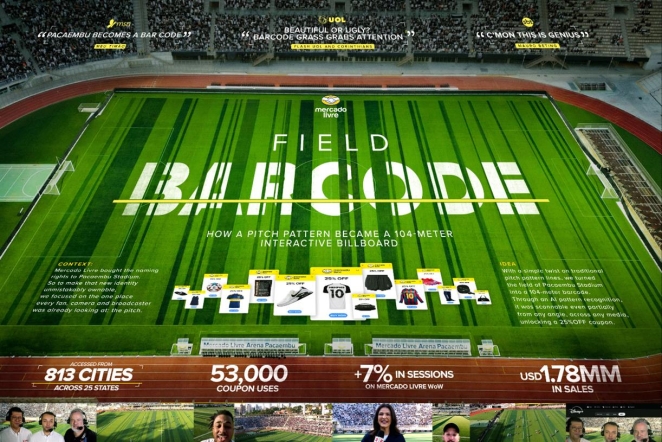
- Mercado Livre’s Field Barcode (above) won Outdoor by turning a football pitch into a giant scannable brand asset.
- Heinz’s Look Familiar? won Print & Publishing by trusting long-built brand memory.
- Uber Eats’ Build Your Own Super Bowl Commercial pushed Media towards participatory, app-native entertainment.
- KitKat’s The KitKat Heist transformed a genuine supply-chain crisis into a PR and social engine.
- Suncorp’s Haven won Titanium by recasting insurance as public-service resilience infrastructure.
- Mother London’s films for Anthropic’s Claude won Film with a challenger stance that satirised the ad-saturated AI race itself.
Several consequential structural shifts also mattered
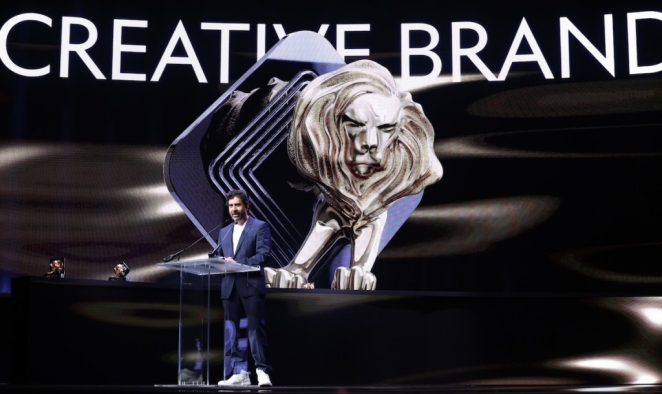
- Creative Brand debuted as a new Lion in 2026, formalising a long-simmering Cannes question: should the systems that repeatedly produce great work be awarded, not just the work itself?
- Cannes also added AI Craft subcategories across Design, Digital Craft, Film Craft, Industry Craft and Creative Data, expanded retail-media recognition, and continued to embed cross-disciplinary communities including LIONS Creators, the new LIONS Sport, the first Global CMO Forum, and the new programme stream Cannes Lions Deconstructed.
- The Festival’s centre of gravity moved further toward boardroom relevance, operating-model scrutiny and creator-led influence.
If there was a defining tension, it was this: AI was everywhere in the programming, in category design and in the conversations around experimentation, but the juries repeatedly rewarded work where technology served a deeply human insight rather than replacing one.
The Croisette was more sceptical about AI overreach than it was in 2025, while sessions from Demis Hassabis, Fernando Machado, and the Ritson/Sharp pairing kept returning to human judgment, distinctiveness, effectiveness and actual brand behaviour.
Cannes 2026 rewarded not one style of work but one standard of work: simple enough to be grasped immediately, brave enough to polarise a room, and sturdy enough to survive scrutiny. That standard helps explain why LePub, Mother, VML, Rethink, Burson, Special, Leo Australia, Uncommon and several in-house teams all had major moments, even though their winning forms ranged from PR opportunism to design systems, interactive commerce, social utility and public-interest infrastructure
The festival’s bigger story
Cannes was always going to be judged in 2026 against the credibility questions that followed the 2025 awards cycle. Organisers entered this year explicitly promising stronger accountability, including senior brand and entrant sign-off, stricter source requirements, AI-assisted verification and a formal Integrity Handbook. By the time the Festival opened, LIONS was clearly presenting integrity not as a side issue but as a central part of creative value.
That context helps explain why overall submissions were materially lower than a year earlier. Cannes did not frame the drop as weakness; it framed it as a more focused field, and Business Insider likewise reported entries were down by roughly a quarter as the tougher rules took hold after the controversies that had shadowed 2025. The result was a festival that felt, in strategic terms, more forensic and more conservative about proof, even while the winning work itself was often disarmingly bold.
It was also a year when Cannes looked more overtly like a business summit. The Festival expanded the CEO Forum, introduced the first closed-door Global CMO Forum, grew its brand and indie presence, and widened its specialist communities. The programme added Cannes Lions Deconstructed as a formal end-of-week analysis stream; LIONS Sport debuted as a two-day programme; and LIONS Creators continued Cannes’ push to treat creator influence less as an adjunct tactic and more as a full commercial discipline.
Category architecture reflected the same shift. The most important 2026 changes were the arrival of the inaugural Creative Brand Lion, the addition of AI Craft subcategories across several craft-led Lions and Creative Data, and expanded recognition for retail media in Media, Creative Commerce, Creative Strategy and Creative Data. Meanwhile, Cannes’ own category history confirms that Social & Influencer had already been renamed Social & Creator in 2025, and that there was no standalone Integrated Lion in 2026; the old Titanium & Integrated formulation exists historically, but Titanium is the relevant 2026 award.
The winners that defined Cannes 2026
The most efficient way to understand Cannes 2026 is to look at the Grand Prix winners in the categories that still organise the industry’s sense of where creativity is heading. The table below focuses on the categories requested, pairing the top winner with why it mattered.
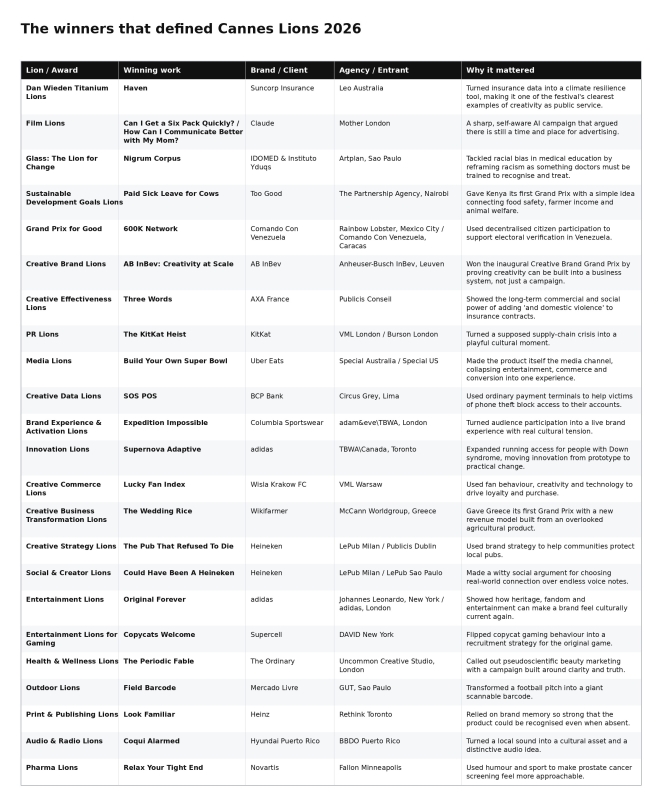
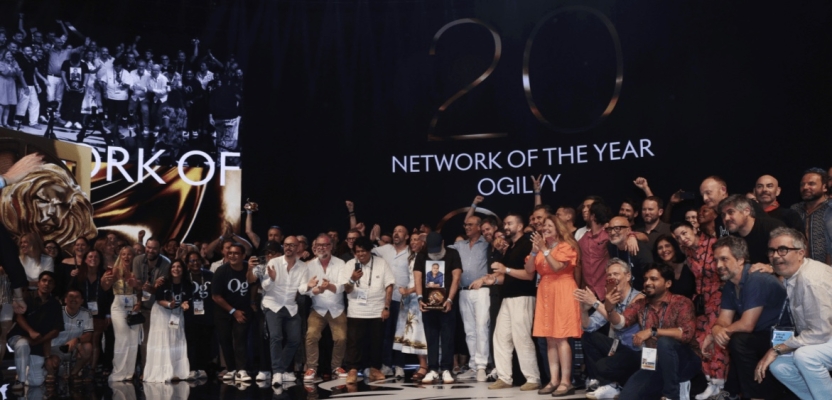
Across the week, the special awards reinforced the same hierarchy of influence. Ogilvy took Network of the Year, LePub Milan was Agency of the Year, Rethink Toronto led the independent field, Heineken was named Creative Brand of the Year, Microsoft? no—this is notable precisely because it was Heineken, a brand whose work now spans social utility, culture-led entertainment and long-range brand system thinking.
The broader medal picture backed up the Grand Prix narrative. Among the categories requested, Cannes’ daily announcements reported the following medal spreads: Outdoor awarded 7 Gold, 13 Silver and 19 Bronze plus a Grand Prix; Print & Publishing 2 Gold, 4 Silver and 6 Bronze plus a Grand Prix; Design 5 Gold, 8 Silver and 13 Bronze; Digital Craft 2 Gold, 3 Silver and 5 Bronze; Film Craft 6 Gold, 15 Silver and 21 Bronze; Social & Creator 8 Gold, 14 Silver and 21 Bronze; Creative Commerce 1 Gold, 5 Silver and 7 Bronze; Film 8 Gold, 14 Silver and 22 Bronze; SDG 2 Gold, 2 Silver and 4 Bronze; and Glass 1 Gold, 1 Silver and 2 Bronze. Those distributions matter because they show where Cannes was highly selective in 2026: notably, Creative Commerce and SDG were unusually tight at the top, which made their Grand Prix calls even more emphatic.
Why the juries went this way
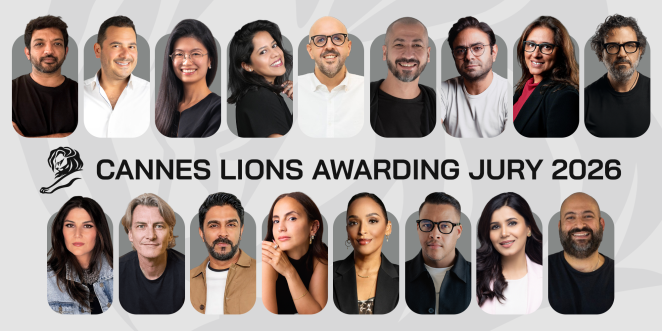
Read across the jury comments and there is a remarkably consistent 2026 doctrine.
First, simplicity beat complication
Aaron Starkman’s Outdoor jury loved Field Barcode because it transformed an instantly recognisable space with one idea. Jessica Apellaniz’s Print & Publishing jury awarded Heinz because the brand had the confidence to subtract. Greg Quinton’s Design jury praised the Apple TV rebrand for feeling human-made in a moment preoccupied with “tech threats”. These are different categories, but they all describe the same appetite: work that says one thing, memorably, then stops.
Second, technology had to serve behaviour, not posture
Andrés Ordóñez’s Digital Craft jury praised Project Genie not simply for frontier AI, but because it turned raw technology into “new creative possibilities”. Phil Camarota’s Creative Commerce jury rewarded Lucky Fan Index because it reimagined what value meant for a football club. Chaka Sobhani’s Titanium jury framed the winning threshold even more starkly: work had to be something the world would miss if it didn’t exist. The common denominator is not AI for AI’s sake; it is usefulness with cultural or business force.
Third, the juries responded strongly to brands taking sides, or at least taking risks
In Brand Experience & Activation, Columbia’s Expedition Impossible was explicitly praised for stepping into controversy in order to challenge irrationality. In Film, Mother’s Claude films were celebrated for turning the rhetoric of the AI category back on itself. In PR, Dana Tahir’s jury rewarded KitKat not for neutralising a crisis but for leaning into it, with creative discipline.
Fourth, business consequences were no longer a polite add-on
This was visible not only in Cannes’ programme architecture and the new Creative Brand Lion, but in the winning work itself. Uber Eats converted entertainment directly into app behaviour; Suncorp connected branded creativity to home-policy growth and policy debate; KitKat turned a logistics problem into enormous earned attention without traditional paid media; and Wisła Kraków used data design to create new fan-engagement and revenue possibilities. Cannes 2026 did not reduce creativity to KPI theatre, but it did insist that the best work changed something outside the case film.
The Festival’s stage programme echoed the same rebalancing. Oprah Winfrey’s LionHeart recognition, Demis Hassabis’ session on AI and authentic storytelling, Fernando Machado’s “Creativity Has to Strike Back”, and the Ritson/Sharp “Five Marketing Truths” session all point to a Cannes that was less intoxicated by automation and more interested in judgment, originality and durable brand effect. Even the official programme framing said the 2026 line-up was designed to reflect how the industry “really works today”, with more interaction, more communities and more post-hype scrutiny.
The consequential news stories behind the trophies
The festival’s own credibility reset
Cannes made creative integrity part of the product, not merely the fine print, and the industry accepted the trade-off: fewer entries, more rigorous claims, less tolerance for embellished case-study mythology. That matters beyond one week in June because Cannes still functions as a career market, a procurement signal and a client reassurance mechanism. Reforming the awards process changes what agencies make, how they document it and what clients are willing to sign.
The rise of the brand operating model as an awardable object
The new Creative Brand Lion makes explicit what many CMOs and agency leaders have argued privately for years: the most powerful creative advantage is not a one-off campaign but a system that can produce distinctive, effective work repeatedly. AB InBev’s win in the inaugural year turned that philosophical shift into institutional reality. For large advertisers, that is consequential because it gives Cannes-sanctioned prestige to organisational design, not just executional brilliance.
The continued formalisation of the creator economy inside Cannes
The category rename from Social & Influencer to Social & Creator had already happened in 2025, but 2026 showed what that rename actually meant in practice: more creator-dedicated programming, more creator-led brand behaviour, and more social work that blurred the boundaries between utility, platform-native behaviour and media planning. Business Insider also noted the new energy and tensions that come with creators operating less like talent extensions and more like independent media businesses.
The return of human craft as a talking point rather than a nostalgic footnote
This is where Cannes 2026 was more subtle than some of its headlines. Yes, AI was built into the awards map and inescapable in the programming. But the standout jury comments repeatedly insisted on human decision-making, taste and materiality. That is not an anti-AI position. It is a clarification that, at least for now, the market still distinguishes between scale and authorship.
Finally, two more specific Cannes news lines deserve mention because they point to future award cycles. One is the arrival of first-ever Grand Prix moments for Kenya and Greece, which Cannes itself highlighted as part of the final-day framing.
The other is the enlarged role for independents, from Mother’s Film win to Rethink’s independent honours and the introduction of a Challenger Pass for indie-owned businesses. That is more than symbolism: it affects hiring, procurement perceptions and the next round of pitch credentials.
Final Thoughts
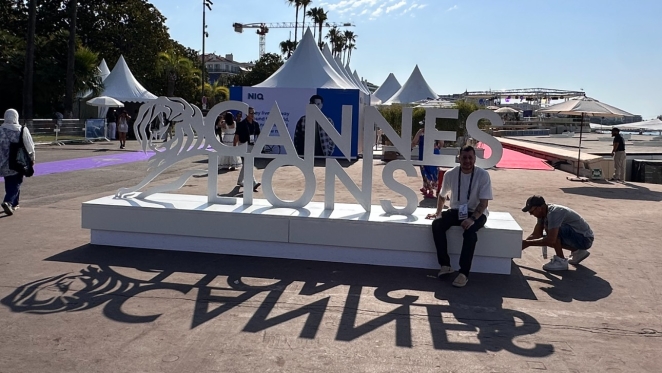
So, if Cannes 2026 taught us anything, it’s that the industry hasn’t been saved by AI, slain by AI, or replaced by a chatbot in a linen suit. What it has done, mercifully, is remember that creativity still has to earn its keep.
The best work this year wasn’t the loudest, cleverest or most technologically gymnastic; it was the work with an actual reason to exist. In a festival built on spectacle, that feels oddly radical.
Cannes may still run on rosé, lanyards and LinkedIn humility posts, but in 2026, the Lions seemed to roar loudest for the brands and agencies that could prove the idea worked after the yacht had sailed.