


It’s no longer science fiction: generative AI platforms are already brainstorming ad campaign concepts that feel as human as those from flesh-and-blood creatives. In one striking experiment in 2023, a panel of seasoned advertising professionals struggled to distinguish student-made ads from AI-generated ones – correctly guessing which was which only 57% of the time, barely better than chance. In other words, the machine-made creative work was practically indistinguishable from human output.
At an industry conference, 300 attendees took this “Ad Turing Test” and fared no better (just 53% accuracy). The contest, organized by BrXnd in New York, even found that the AI-crafted ads for a fictional energy drink performed nearly as well on consumer appeal metrics as typical print ads – a jaw-dropping validation of AI’s creative prowess.
Creative leaders are taking notice. RG Logan, chief strategy officer at Grey New York, predicted that “as we look toward 2025, it’s likely we’ll see a generative AI ad that passes the Turing test, making it indistinguishable from one created by humans”. He noted that while today’s AI-generated campaigns sometimes carry an uncanny hint of their origins, “what feels slightly off today will likely feel seamless tomorrow”.
In short, AI is fast shedding its training wheels. With such power comes a thorny question: Should agencies keep it a secret when AI is behind the big idea or the polished copy? Or is it time to mandate full transparency – to outlaw those “secret AI co-author” situations and openly credit the algorithms that now work alongside humans?
The Case of the Invisible Co-Author
Walk into any buzzing agency brainstorming session today and there’s a good chance an AI tool is quietly in the mix – suggesting headlines, mocking up visuals, or even writing first drafts of copy. Yet, in many final deliverables, the AI’s role remains a ghost in the machine, unmentioned to clients or audiences.
Agencies have historically treated software as just part of the craft; after all, nobody writes a pitch deck footnote to say “Image retouched in Photoshop” or “Fonts kerned with InDesign.” By that logic, one might argue: Does using ChatGPT or Midjourney really require a disclosure? Some creatives compare AI to a calculator – a powerful aid, but ultimately just a tool to execute a human-directed vision. “Does their accountant use a calculator? It’s really no different,” quipped one agency professional, suggesting that employing AI in creative work shouldn’t be seen as scandalous or even noteworthy if it’s simply making the job easier.
There’s also a fear factor at play. What if clients start to question agency value if they know AI played a part? In an online discussion among marketers, some worried that clients might say, “Why am I paying you agency rates for something an AI could do for free?” This concern isn’t hypothetical – it’s already been voiced by marketing managers wary that they might be “paying for something they could do themselves” if they found out an agency used ChatGPT behind the scenes.
Creative teams, too, grapple with pride and identity: if an award-winning concept was seeded by an AI prompt, does that diminish the creative director’s glory? These sentiments lead many to keep AI assistance hush-hush, or to euphemize it as just using “a suite of various tools” in client contracts. In short, there are plenty of incentives to let the AI ghostwriter stay ghostly.
But secrecy has its risks. An undisclosed AI co-author can backfire spectacularly when discovered. Just ask the tech writers at CNET. In early 2023, CNET’s parent company quietly deployed an AI to write dozens of finance articles – without a prominent disclosure to readers. The result? Public outcry when the practice came to light, especially after more than half the AI-written stories were found to contain errors and even plagiarized phrases.
CNET had to issue corrections on 41 of 77 AI-generated articles and hastily slapped editor’s notes atop them admitting the use of an AI tool. The episode was a journalistic black eye and a lesson in transparency: audiences don’t appreciate feeling misled about who (or what) is behind the content they consume. While creating ads isn’t journalism, the trust equation is similar for brands and agencies – credibility can take a hit if AI’s role is revealed after the fact.
Even in politics, AI’s covert role is stirring debate. Just days ago, a local news outlet reported that a New York City Council candidate’s website was using AI-generated images of smiling supporters, stock scenes and even a smartphone screenshot – none of them labeled as such. To the naked eye, the images looked almost normal, but tell-tale glitches (distorted faces, nonsensical text on the phone screen) gave away their algorithmic origin.
Observers questioned the ethics: should a political campaign disclose that those “real people” aren’t real at all? If this practice proliferates, will we be able to trust any images in advertising or campaigning? These examples underscore the reputational and ethical minefield of hidden AI authorship.
Why Some in Adland Resist Full Disclosure
Balanced against transparency advocates are those who argue that requiring an “AI inside” sticker on creative work is overkill – or even counterproductive. For one, creativity has always involved building on tools and inspiration that go uncredited. A creative team might use stock photography, algorithmic music generators, or copy templates without a public confession. Why single out generative AI for a special call-out? One reason might be the degree of authorship.
AI today isn’t just a tool like a paintbrush; it can be an active partner that contributes whole ideas or executions. Still, skeptics of disclosure say, ultimately a human is accountable for the final output, and that’s what matters. As long as the agency ensures the work meets the brief and delights the audience, does the creative process need to be transparent?
Then there’s the audience perspective. Some marketing veterans worry an overt AI credit could distract or even alienate consumers. If a billboard’s fine print said “This campaign was co-created with AI,” would it make people suspicious or wary of the message? Perhaps – especially if done clumsily.
Tone matters: bragging about AI can sound gimmicky or “cringey,” as one digital creative director pointed out. There have already been cases of brands touting “We used AI to make this ad!” as a PR stunt, only to be met with consumer indifference or eye-rolls. If disclosure comes off as boastful (“look how cutting-edge we are”) it might indeed backfire, making the brand seem less human and more cost-cutting.
The nuance, as VML South Africa creative director Tilesh Bhaga notes, is that transparency shouldn’t be about flexing tech for its own sake. “Consumers love brands that feel genuine,” Bhaga writes – and if a disclosure feels like a tech bro patting himself on the back, audiences could actually lose trust. Ironically, disclosing AI for bragging rights can send the message that a brand cares more about shiny new tools than about human creativity or authenticity.
Another argument against mandatory disclosure is the slippery slope of what counts as “AI involvement worth noting.” If an art director uses an AI tool to slightly enhance a photo – say, to clean up backgrounds or improve lighting – that’s no different from conventional retouching. For years, agencies have manipulated images with software without a footnote, as long as it wasn’t materially misleading.
Many uses of AI today are similarly benign: grammar checks, colorizing an image, formatting layouts, A/B testing variants. Requiring disclosure in every one of those cases (the argument goes) would be like writing “Spellcheck was used in the making of this brochure” – an unnecessary overload of information. Over-disclosure could even confuse consumers, obscuring the message with irrelevant details.
These are valid concerns, and any policy on AI transparency will need nuance. But they must be weighed against the clear benefits – and emerging demands – for honesty about AI’s role.
The Case for Transparency: Ethics, Trust, and Creative Integrity

On the other side of the debate, a growing chorus of voices – from agency leaders to regulators to consumers themselves – is arguing that AI usage should always be disclosed in agency work, or at least far more often than it is now. The rationale spans ethical, creative, and business considerations:
Truth in Advertising (and PR)
In the PR world, where trust is currency, some leaders are already pushing for full transparency. “Agencies should always make it crystal clear to clients when and how they use AI tools,” says Sam Patchett, client director at PR agency Profile. Patchett warns that if an agency secretly uses, say, ChatGPT to generate content but still charges the client as if a team of humans wrote it from scratch, “there’s a risk clients could be seriously over-charged… which could seriously undermine trust in the industry.” In plain terms: hiding AI can amount to overbilling and erode the client-agency relationship. Transparency is an antidote, ensuring the client knows what they’re paying for. Following his own advice, Patchett’s firm even published an “AI Disclaimer” detailing exactly how they incorporate AI in services like media monitoring, copywriting and research. This kind of openness, he argues, should become standard practice.
Consumer Trust and Brand Goodwill
What about the end audience? Research suggests that brands have little to fear – and much to gain – by being upfront. A recent Yahoo/Publicis Media survey found that when consumers noticed a disclosure that an ad was AI-generated, their perception of the brand actually improved significantly. In that study, AI-crafted ads with transparency saw a 47% lift in ad appeal, a 73% jump in perceived ad trustworthiness, and an astonishing 96% boost in overall trust toward the company, compared to similar ads with no disclosure. In other words, people appreciate the honesty. Rather than thinking “oh no, a robot made this ad, I feel cheated,” audiences on the whole responded with greater trust, likely because the brand wasn’t trying to pull the wool over their eyes. In an age of deepfakes and disinformation, transparency itself is a selling point.
Elizabeth Herbst-Brady, Yahoo’s Chief Revenue Officer, noted that consumers are “less concerned about brands using AI, but rather [want] to identify when AI is used. Transparency will be vital for brands to maintain long-term consumer relationships.”. The public knows AI is increasingly part of production – over 60% of consumers assume AI is used in ads in some form – so hiding that fact is more likely to seem deceptive than reassuring.
Upholding Creative Credit and Authenticity
From a creative ethics standpoint, disclosing AI involvement is akin to crediting a collaborator. If a copywriter had substantial help from a colleague, you’d expect an acknowledgment; if a campaign was adapted from someone else’s concept, you’d want to know. AI might not have an ego to soothe, but giving it a silent co-author role raises questions of intellectual honesty. There’s also a subtler issue of cultural transparency: for instance, if an AI trained on countless artworks generates a visual style for a campaign, some argue that it’s only fair to disclose that, just as you’d cite inspiration or avoid outright plagiarism. Non-disclosure, in this view, brushes under the carpet the reality that AI is remixing human creations at scale. Artists and writers have already voiced concerns about their work being absorbed into AI models without credit – hiding AI usage in creative outputs could be seen as doubling down on that lack of attribution. Openly labeling AI-assisted work might encourage more responsible use of these models and respect for original creators (e.g. ensuring the AI isn’t regurgitating someone else’s protected material). In short, transparency can help navigate the murky ethics of creative ownership in the AI era.
Mitigating Misleading Content
Transparency isn’t just a philosophical nicety; it has practical implications for truthfulness. The Advertising Standards Authority (ASA) in the UK points out that current rules against misleading advertising apply regardless of how an ad is made. If an AI is used to, say, create an image of a perfectly fit model to sell a fitness product, that image must not deceive about results – disclosure that it’s AI-made won’t excuse a fundamentally misleading impression. However, the ASA and industry bodies have acknowledged scenarios where disclosure can prevent misunderstanding. In new guidelines, the Incorporated Society of British Advertisers (ISBA) and the IPA advised that advertisers “should ensure that their use of AI is transparent where it features prominently in an ad and is unlikely to be obvious to consumers.” For example, if an ad shows an influencer who is actually a digitally generated avatar, a viewer might wrongly assume a real person endorses the product – a clear case where a label “virtual influencer (AI-generated)” would set the record straight. The same could apply to AI-synthesized voiceovers or fictional testimonials. Ethically, if something significant in an ad isn’t what it seems, disclosure is the remedy.
The Magic Touch
Finally, transparency might benefit the creative industry’s reputation at large. If agencies widely embrace AI but keep it secret, there’s a risk of a future reckoning – a “gotcha” wave of revelations that much work was partially machine-made. That could feed cynicism that Madison Avenue is pulling a fast one on clients and consumers. Conversely, normalizing AI’s open presence in creative workflows could reinforce agencies’ credibility: they have nothing to hide, and they stand behind the quality of AI-assisted work openly.
It also pushes creatives to higher standards – you can’t quietly lean on the AI for a concept and then later claim pure human genius; if everyone knows AI was involved, the focus shifts to how you guided the AI and added human magic. In that sense, transparency could actually elevate the craft, encouraging creative teams to make the combination of human and AI as fruitful and original as possible. After all, as marketing innovator Noah Brier put it, AI is “the most amazing creative accelerant I’ve ever experienced” – but the key word there is accelerant, not replacement. The human touch remains crucial, and disclosing AI’s role clarifies that division of labour.
Toward Industry Standards (and Laws?) on AI Disclosure
The debate may soon be moot if official policies step in. Around the world, regulators and industry groups are grappling with AI’s impact and largely coalescing around one principle: transparency must improve. There’s precedent in adjacent fields. In the US, the Federal Election Commission is considering rules to require candidates to label AI-altered content in political ads, after incidents of “deepfake” attack ads stirred alarm in the 2024 cycle. Several states have already enacted laws mandating disclosure if AI-generated media is used in election materials. While those laws target the political realm, they signal a wider expectation that when AI imitates reality, the audience has a right to know. It’s not hard to imagine truth-in-advertising regulations following suit for commercial ads if abuses mount.
The EU’s sweeping AI Act, taking effect in phases, will require certain transparency measures – for instance, if an AI generates an image or content that could be mistaken for real, it may need to be flagged as AI-generated under the law. Advertising uses might fall under these rules, especially for high-stakes products (finance, health) or scenarios where not disclosing AI could cause consumer harm. Advertisers globally will feel the ripple effects of such regulations when marketing in those jurisdictions.
Self-regulation is moving as well. As mentioned, Britain’s ad industry groups issued guiding principles in 2023, specifically urging openness about AI when it’s a major element of the creative. In the U.S., the Ad Council and 4A’s (American Association of Advertising Agencies) have convened ethics panels on AI – one outcome may be recommended best practices on disclosure to pre-empt heavier-handed legislation. Major platforms (like Meta and Google) already have policies for political ads requiring disclosure of synthetic media, and they could extend similar policies to commercial ads to keep user trust (Facebook’s policy team has hinted at this). We’re essentially witnessing the start of an AI transparency norm: today it might be encouraged or situational, but tomorrow it could be as standard as including an “#ad” tag on sponsored content.
Agencies that get ahead of this curve could actually differentiate themselves. Much like brands now tout fair-trade sourcing or eco-friendly practices, imagine an agency pitching a client: “We use AI in our creative process, and we’re proud to be fully transparent about it. Here’s exactly how AI contributed to these ideas.” It turns a potential stigma into a badge of responsibility. Some agencies may even start building disclosure into their deliverables by default – e.g. a note in the credits of a campaign case study, or a slide in the pitch deck that says, “Concepting assisted by AI tools (Midjourney visuals for mockups, ChatGPT for initial copy brainstorming).” It’s not about downplaying the human work, but framing the AI as part of the team. After all, if AI truly is a co-author, why pretend it’s not in the room?
Conclusion: Embracing an Honest Future of Human-AI Creativity
Secret AI co-authors may be convenient in the short term, but they’re a gamble with trust that the creative industry doesn’t need to take. The balanced view acknowledges that not every use of AI warrants a public service announcement – we don’t expect a photographer to label which images were edited in Lightroom.
There is a grey area, as Tilesh Bhaga points out, where AI is just one tool among many and overly rigid rules could be cumbersome. But when AI moves from minor assist to major author – when an agency is effectively collaborating with a model to generate what it delivers – the scales tip toward the public’s right to know. As Bhaga wisely notes, the question is less whether to disclose and more how to do it meaningfully. The goal isn’t to shame agencies for using AI, nor to overly glorify it, but simply to “keep yourself honest in the public eye, while maintaining a high standard of creativity and value.”
Honesty can be provocative – it forces us to discuss openly what the role of human creativity is when machines can do so much. Yet that conversation can strengthen the industry. If agencies disclose AI involvement, they also implicitly underscore what only humans in the process can do: inject true emotion, strategic insight, humour born of lived experience, cultural nuance.
It tells clients and audiences, “We use every tool at our disposal, including AI, to give you the best results – and we stand by those results transparently.” In an era when so much media content might soon be AI-touched, the agencies that lead with transparency will build deeper trust. They’ll also set a standard that separates responsible, creative AI use from the Wild West of slapping together AI outputs for a quick buck.
Perhaps it’s time the industry treats undisclosed AI authorship the same way it would treat undisclosed stock plagiarism or undisclosed conflicts of interest – as an unethical practice to be rooted out. Outlawing secret AI co-authors might not mean literal legislation so much as a new norm of accountability. And the upside is, there’s tangible proof that transparency pays off. Brands that admitted “a little help from AI” saw spikes in consumer trust, and agencies that tell clients about their AI use can foster stronger partnerships built on candor.
The genie (or generative model) is out of the bottle in our creative world. There’s no going back – nor should we want to, given the incredible possibilities AI affords. But as we move forward, it’s imperative to bring our audiences and clients along openly. Sunlight is the best disinfectant, and in this case it can shine a light on the positive potential of human-AI collaboration, rather than casting a shadow of secrecy.
So yes, it’s time for our industry to say it clearly: if AI was in the room when the big idea was born, let’s acknowledge that. Credit the co-author and take pride in the creative alchemy that results. In doing so, we’ll ensure that “artificial” intelligence doesn’t erode the authentic connections we build through our work but instead enhances them under the watchful eye of an informed public.
In the end, being real about our use of the unreal may be one of the smartest creative moves we can make. After all, transparency is a form of truth, and great advertising, at its heart, thrives on truth well told.
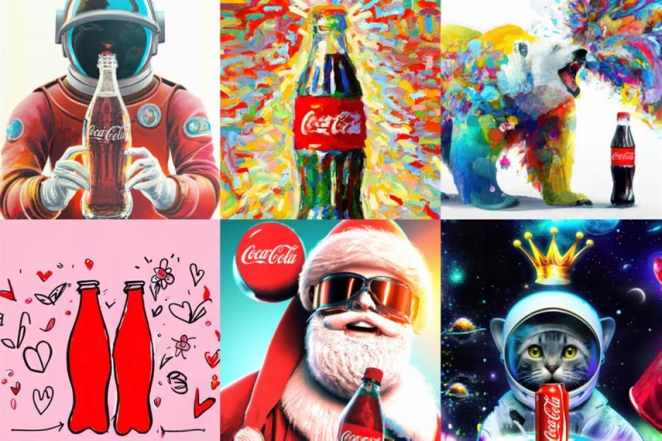
(Full disclosure: No AI was harmed (or hidden) in the writing of this article – though a few were consulted! This images on the otherhand, were all generated via Midjourney)