

When Trey Parker and Matt Stone were tasked with writing a new season of South Park in the wake of Donald Trump’s first run at dismantling democracy, they opted to largely avoid the topic. In their eyes, reality had become so ridiculous as to be beyond the scope of satire. I always saw that as taking the easy way out.
Sometimes you need to hold up a literal mirror to these maniacs
Thankfully, this spin around the asylum has already proven so insane, that creatives across the board are already reaching for the most valuable tool in their arsenal to combat absurdity – more absurdity. Because sometimes, you need to hold up a literal mirror to these maniacs to help them realise just how far they’ve fallen. Of course, the message is unlikely to land, but at least we’re still trying!
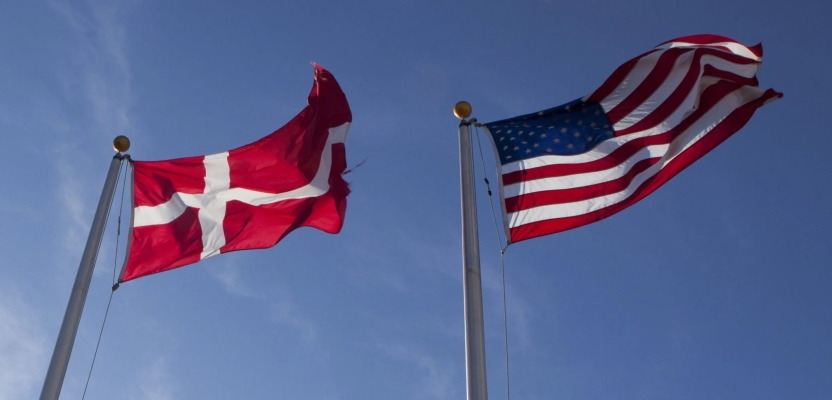
I was particularly emboldened this week to come across the country of Denmark’s resolutely tongue-in-cheek “Denmarkification” campaign in response to the reliably baffling Trump proclamation that he’s willing to “take the Danish territory of Greenland by force”. In response, over 200,000 Danish citizens have signed a petition to “buy” California for a trillion dollars—perfectly encapsulating how creative humour can always disarm even the most frustrating fascist rhetoric and transform geopolitical absurdity into cultural commentary. I can’t wait for the Gazan tourist authority to follow suit.
A Masterclass in Creative Resistance
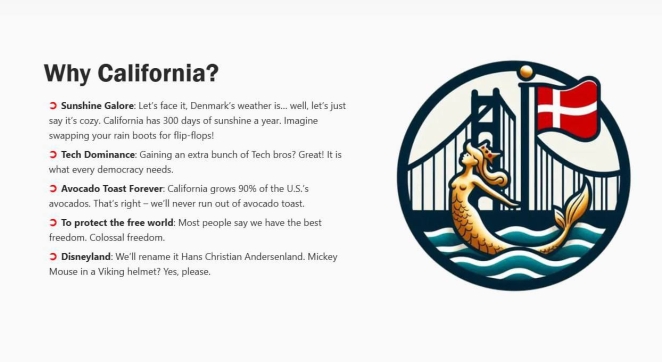
This tongue-in-cheek proposal flips the script on the great orange authoritarian’s Putinesque tirade by suggesting that if Trump’s grandiose ideas are on the table, then so should be a theoretical takeover of the Golden state. By proposing to rebrand Disneyland as “Hans Christian Andersenland” and picturing “Mickey Mouse in a Viking helmet,” the campaign doesn’t pull any punches and
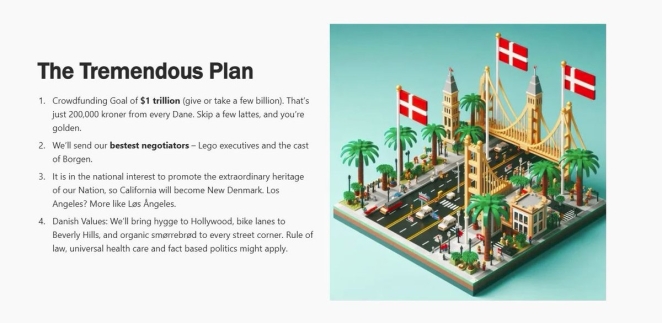
Led by campaigner Xavier Dutoit, the initiative envisions transforming California into a territory imbued with Danish “hygge”—from bike lanes in Beverly Hills to organic smørrebrød on every corner. With a crowdfunding pitch that jests “just 200,000 kroner from every Dane,” the movement not only mocks coercive geopolitical ambitions but also affirms that humour can level the playing field when official diplomacy descends into absurdity.
Even the suggestion that negotiations be handled by Lego executives (experts, after all, in managing tantrums over missing bricks) perfectly illustrates the creative subversion at play. It’s also something that you know would piss off Trump (if he wasn’t being shielded by such things by his drooling sycophants) and that alone makes it worthwhile, surely?
Historical Precedents: Humour as Resistance
The use of humour to combat fascism is not new, of course. History offers striking examples of creative defiance in the face of oppressive regimes:
Charlie Chaplin’s The Great Dictator (1940)
Perhaps the most iconic instance, Chaplin’s film used biting satire to ridicule Adolf Hitler and the Nazi regime at a time when direct criticism could be deadly. The film’s blend of comedy and political commentary not only undermined fascist ideology but also galvanized audiences around the world.
Wartime Caricatures and Cartoons
Throughout World War II, publications like Britain’s Punch magazine and underground presses in occupied Europe published cartoons that lampooned fascist leaders and ideologies. These images served as a morale boost and a subtle form of resistance, using humour to spotlight the absurdities of totalitarianism.
Satirical Art in the Spanish Civil War
In Spain, where fascism clashed with republican forces, underground satirical art became a medium for dissent. Artists risked their lives to create works that skewered the authoritarian tendencies of their adversaries, echoing the sentiment that laughter could be a form of defiance even in the darkest times.
From Greenland to California: A Geopolitical Parody
The satirical campaign also serves as a pointed counter-narrative to Trump’s ambitions. While the U.S. president threatened to acquire Greenland—an autonomous Danish territory hosting strategic military installations—the Danish response was to invert the narrative. Instead of yielding to threats or resorting to military brinkmanship, Denmark’s creative community embraced irony.
By proposing to “buy” California through a playful crowdfunding effort and by punning on everything from avocado toast to rebranding Los Angeles as “Løs Ångeles,” the movement turns high-stakes geopolitics into a farcical commentary on modern power plays.
In this context, “Calexit” isn’t about literal secession; it’s a metaphor for creative liberation. It symbolizes the refusal of the creative community to be confined by rigid, fear-based politics. By imagining a future where Californian streets are imbued with Danish values—where even a lifetime supply of Danish pastries might sweeten the deal—the campaign envisions an alternative order where universal healthcare, the rule of law, and fact-based politics prevail over hate and division.
The Transformative Power of Humour
History teaches us that when authoritarianism takes itself too seriously, it is our laughter that reveals its inherent absurdity. Whether it was Chaplin’s defiant laughter in The Great Dictator or the underground cartoons that sparked hope in war-torn Europe, humour has always dismantled the pretensions of oppressive regimes. Today, Calexit and the Denmarkification campaign continues this proud legacy—reminding us that creative resistance is not merely about entertainment; it is about reclaiming our shared humanity.
In the battle against fascism, satire is both shield and sword
In the battle against fascism, satire is both shield and sword. It disarms xenophobia, exposes the ridiculousness of unchecked power, and offers a hopeful vision of a society where diversity and creativity triumph. Let this be our call to arms: when politics become absurd, let our laughter be the revolution.

Luigi Mussardo February 17th, 2025, in the morning
Great article, also a reassuring one! Keep up