

Every graphic designer has faced this moment: a client sends you a JPEG file — often a pixelated logo, a screenshot, or even a photo — and says:
“I just need this turned into a vector file, exactly the same. Don’t change anything.”
It sounds simple. But here’s the truth: it’s one of the hardest requests to explain to someone outside our field.
-
The Core Problem: Raster ≠ Vector
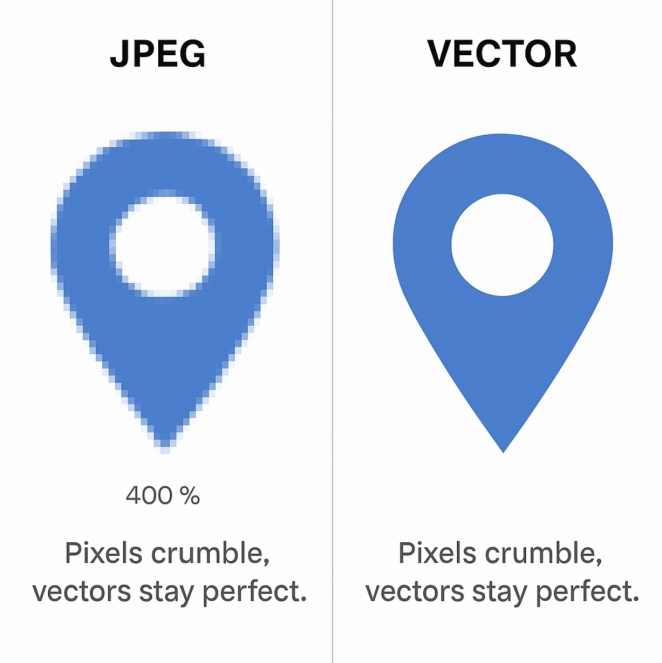
A JPEG (or PNG) is made of pixels — tiny squares of colour arranged in a grid. Zoom in, and you’ll see the edges break down into jagged, blurry blocks. That’s raster.
A vector, on the other hand, is built using mathematical paths and curves. Every line, shape, and gradient is infinitely scalable and editable. There are no pixels — just clean geometry.
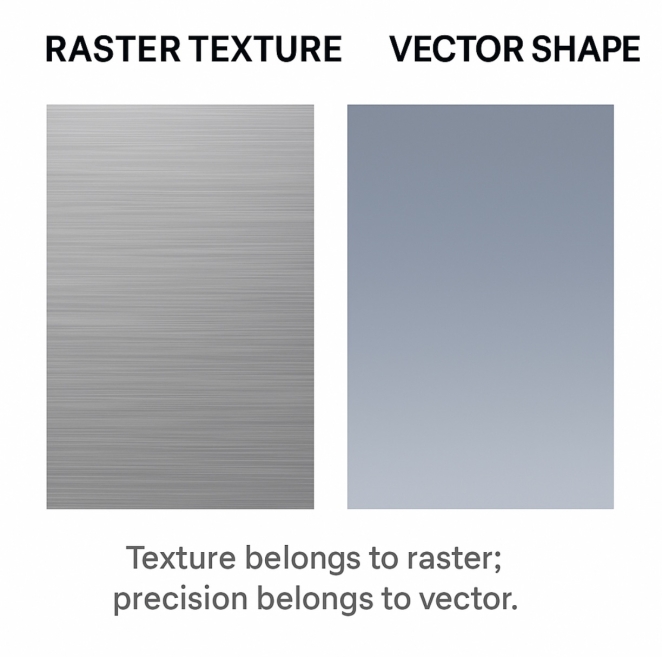
So when a client asks for an SVG of a JPEG without changing anything, it’s like asking an architect to build a 3D model of a photo, but insisting that every shadow, every smudge, and every imperfection must remain untouched. It’s simply not possible — because raster images capture texture; vector art captures structure.
-
Why Clients Struggle to Understand
For non-designers, images are just images. They open a file, it looks fine, so why can’t we just “save it as SVG”?
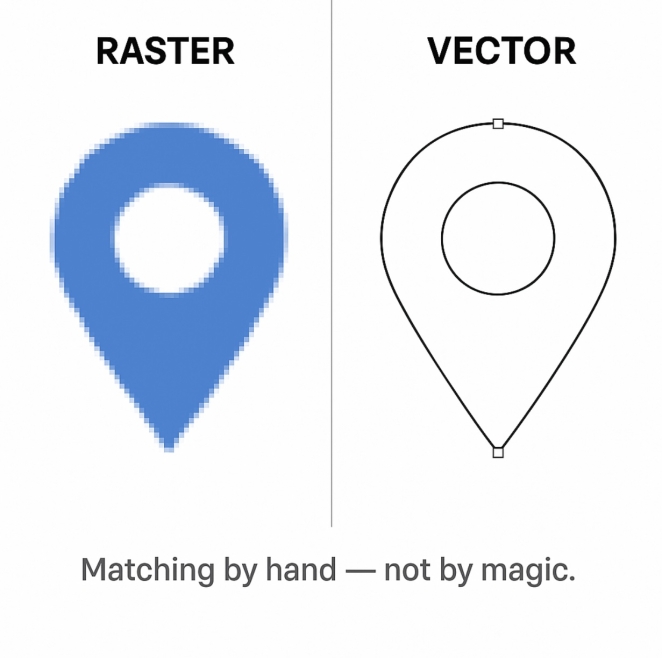
But for us, vectorising isn’t a “Save As” function. It’s a process of redrawing, reconstructing every curve by hand or through intelligent software tracing. We have to rebuild the logo from scratch — not trace pixels, but interpret shapes.
And interpretation means tiny differences will exist. Maybe the shadow softens, a texture flattens, or a gradient smooths out. To the human eye, it’s 99.9% identical. But to someone emotionally attached to their logo’s exact look, that 0.1% feels like a loss.
-
The Designer’s Dilemma
As designers, we walk a fine line between technical truth and emotional diplomacy.
We know vectorisation improves quality, scalability, and print accuracy. But clients often fear that change means “losing the original look.”
It’s our job to explain — patiently — that:
- Vector art is about clarity, not copying pixels.
- SVGs can’t reproduce raster textures exactly.
- Rebuilding from scratch ensures longevity, not just replication.
Sometimes, showing visuals speaks louder than any technical explanation.
-
How I Convince Clients (Without Sounding Technical)
Here’s the conversation I often have:
“Think of your JPEG as a photograph — full of light and shadow.
A vector is more like a blueprint. I can rebuild your design in vector form so it’s sharp and professional on any scale, but it won’t capture every tiny photographic detail — and that’s actually a good thing. It ensures your logo stays timeless, adaptable, and ready for print, web, and animation.”
Framing it this way transforms a technical limitation into a value proposition.
Clients begin to see that this isn’t about changing their design — it’s about future-proofing it.
-
Closing Thought
The real challenge isn’t converting pixels into paths — it’s converting perception into understanding.
Vectorisation is both art and science: a balance between respecting what exists and re-crafting it to last forever.