Shawnee Dee
Founder
ABOUT
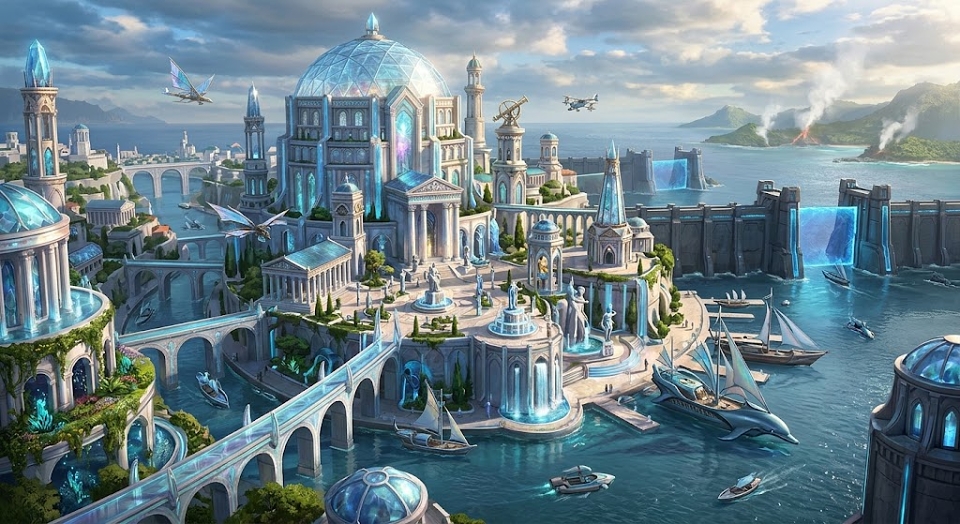
The Atlantis Renaissance Theory begins with a simple but transformative premise: what appears lost is often not truly gone. Throughout history, mythology, and human experience, there are periods when people, communities, ideas, and dreams seem to disappear beneath the weight of adversity, neglect, failure, trauma, or obscurity. Like the legendary city of Atlantis, they sink below the surface of visibility. Yet beneath that submersion, essential elements remain intact. The theory explores how dormant potential survives periods of decline and how renewal becomes possible through intentional rediscovery and reconstruction.
The brief of the theory is to examine the relationship between loss and renewal. Rather than accepting disappearance as an ending, the theory asks whether apparent destruction may actually be a hidden stage of transformation. It challenges conventional assumptions that equate invisibility with irrelevance or failure with finality. The core question is whether people, institutions, cultures, and aspirations possess the capacity to endure beneath the surface until the conditions for their reemergence are created.
The approach follows a process that begins with submersion. During this phase, an individual, community, organization, or vision experiences setbacks that push it out of public view. This may occur through social exclusion, systemic barriers, personal hardship, economic decline, cultural forgetting, or other forces that prevent growth and recognition. What remains visible is often only the loss, while the surviving strengths, knowledge, and possibilities remain hidden.
The next phase is discovery. Here, attention shifts from what was lost to what survived. Forgotten stories are revisited, overlooked talents are recognized, and hidden foundations are uncovered. Discovery is the moment when value is identified beneath the surface. It is an act of questioning accepted narratives and searching for overlooked potential that still exists despite years of neglect or suppression.
Following discovery comes reconstruction. This stage involves gathering the fragments that remain and intentionally rebuilding. Reconstruction may take the form of healing, education, innovation, advocacy, leadership, creative expression, or community development. The objective is not merely to restore what once existed but to understand it deeply enough to create something stronger and more sustainable. Reconstruction transforms survival into purpose.
The final phase is renaissance. Renaissance represents the emergence of a renewed identity, system, culture, organization, or vision. What returns is not an exact replica of the past. Instead, it is a transformed version shaped by lessons learned during submersion and strengthened through reconstruction. The renaissance embodies resilience, wisdom, and renewed possibility.
The result of the Atlantis Renaissance process is the realization that loss does not necessarily signify an ending. Individuals reclaim identities once diminished by circumstance. Communities recover histories that were overlooked. Organizations rediscover missions that had become obscured. Dreams once abandoned find new pathways into reality. The outcome is a renewed state of being in which hidden value becomes visible and dormant potential becomes active.
In its simplest form, the theory can be summarized as follows: Submersion reveals what must be endured. Discovery reveals what remains. Reconstruction creates what can become. Renaissance reveals what was possible all along. The Atlantis Renaissance Theory therefore reframes adversity not as proof of defeat, but as a stage in a larger cycle of renewal, demonstrating that what disappears beneath the surface may one day rise again with greater strength, purpose, and meaning than before.
AWARDS
NOVA Award