TDC PR
London
ABOUT
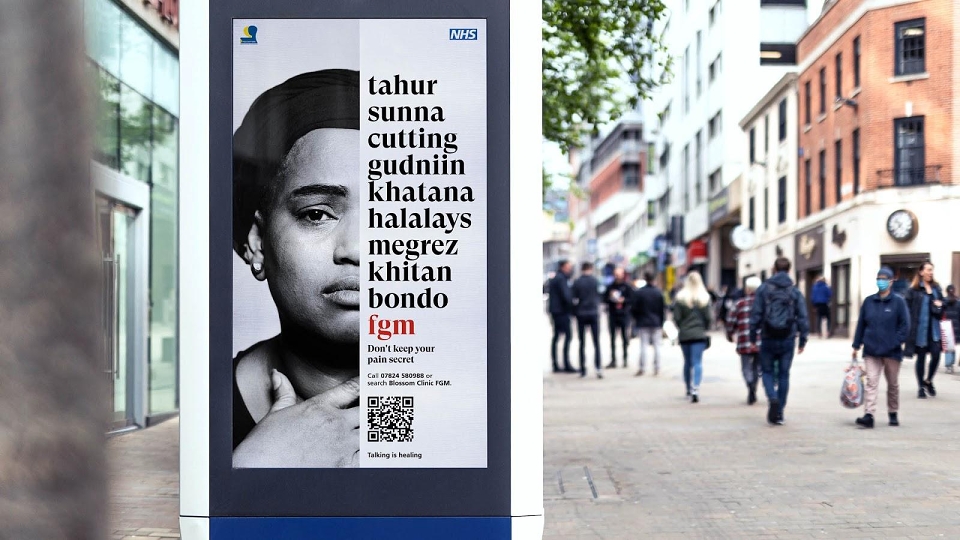
Leeds Health and Care Partnership, on behalf of NHS West Yorkshire Integrated Care Board (Leeds office) reveals its health campaign to raise awareness around the illegal practice of female genital mutilation (FGM). The campaign aims to encourage women who have undergone or have experienced physical and psychological problems as a result of FGM to seek support at its Blossom Clinic which serves the entire north of England.
FGM has been outlawed in the UK since 1985 but the risk to women and girls especially under the age of 15 remains significant: 60,000 are believed to be at risk and an estimated 137,000 women have undergone the procedure.
NHS West Yorkshire ICB in Leeds wanted to spearhead an impactful but sensitive campaign appealing to survivors who typically live in wider communities higherw levels of deprivation, and where women navigate both language and stigma barriers, to come forward and seek help.
Partnering with Thompson - a brand and design consultancy with a specialism in health and wellbeing sectors - a careful cohesive narrative was created comprising the brave accounts of women, told in their own voices and native tongue, describing how their lives have been impacted and scarred by FGM.
“We were entrusted with a huge responsibility to handle and convey these incredibly painful but important stories in a way that was sensitive, respectful and did not scaremonger,” commented Chris Skelton, creative director, Thompson. “It was important to start from a place of empathy and reiterate that the Blossom Clinic provides a safe space in which to not only explore and eventually process these traumas, but to have access to the medical procedures available to help with the repercussions of the criminal practice. Language is a powerful tool that has the power to validate one’s existence or to ‘other’. As creatives, we have to tread considerately to ensure tone is as sensitive as it is impactful. We also worked with photographer, Ejatu Shaw, whose work has previously explored cultural identities. Ejatu is of Fulani heritage where FGM is widely practised, so she felt it was important to meet with FGM survivors and photograph them in a way that empowered them.”
On both physical and digital touchpoints, Thompson developed and implemented layers of messaging and graphic styles to effectively communicate the call to action. Sharp typography, GT Super by Grilli Type, was used as a subtle reference to a knife (the surgical implement used for FGM) but with a level of softness as a nod to empowerment. The font sits adjacent to a half portrait of a survivor with the simple statement: ‘Talking Is Healing’, symbolising how FGM takes something away from the person, both emotionally and physically. FGM is then re-written in multiple languages to reflect the myriad ethnic groups affected to transcend the cultural communication barriers.
Chris Skelton continued: “The truth about FGM is genuinely shocking and it's easy to become focused on the horrors of the practice procedure itself. However, we understood that we had a very specific task with our campaign – to reach out and encourage these women to get in touch with the Blossom Clinic, not forgetting that many of them would be in pain, feeling helpless or frightened. The messaging therefore would have to offer empathy and reassurance. This insight led to the central theme for the campaign – Talking Is Healing - which underscores the entire call to action of the campaign; encouraging survivors to talk out against the practice and to seek both clinical and emotional support”
Karen Lambe,NHS West Yorkshire ICB in Leeds, commented: “The task we set was not an easy one. We needed a partner that showed a deep understanding of the sensitivities around FGM and a real empathy with the survivors. These vital elements needed to come through in the campaign that raises awareness of the vital services that the Blossom Clinic provides to a number of hard-to-reach communities. Thompson was able to strike a balanced tone that is striking in its humanity yet sensitive to the women whose stories we tell.”